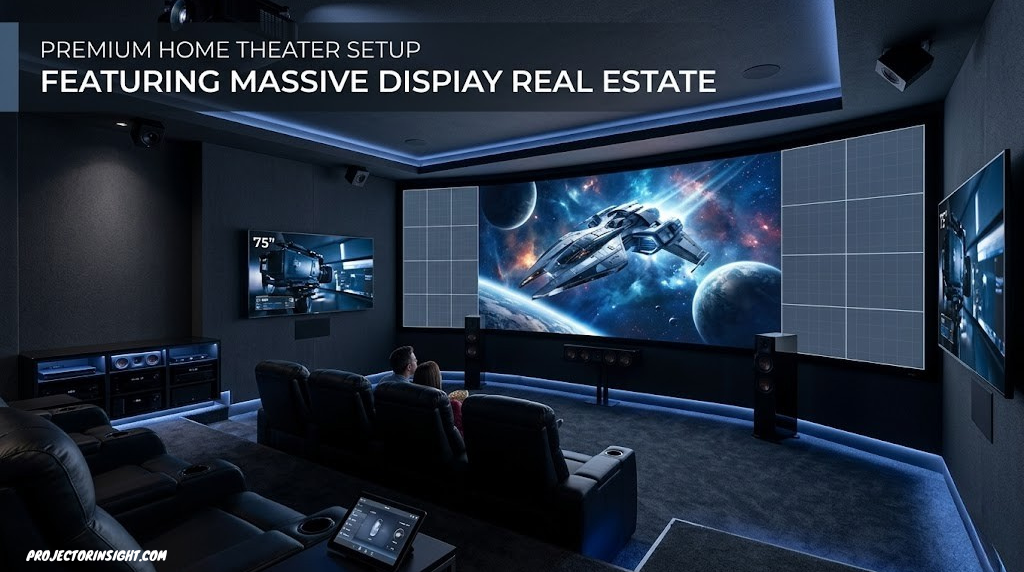
Projector vs 85 inch TV: The Ultimate Home Cinema Comparison Guide
An exhaustive, technical, and practical evaluation of optical projection systems versus direct-view ultra-large televisions to help you build the absolute perfect entertainment sanctuary.
1. Introduction & The Paradigm Shift in Big-Screen Home Entertainment
The pursuit of an immersive cinematic experience within the home has entered a golden age. For decades, the boundary line between traditional televisions and projection systems was clear: televisions offered bright, pixel-dense imagery at modest sizes, while home theater projectors commanded a monopoly over true, wall-sized cinematic immersion. Today, that boundary has dissolved entirely.
Consumer electronics manufacturers have successfully scaled direct-view LED and QLED panels up to massive proportions, making massive flat panels increasingly accessible. Concurrently, projection technology has undergone an architectural rebirth. The development of solid-state laser light sources and ultra-short-throw optical blocks allows modern projection packages to stand toe-to-toe with dedicated televisions in spaces previously deemed completely unsuitable for light-based projection systems.
When engineering your ideal viewing environment, choosing between a high-end projection configuration and an expansive direct-view television is no longer a simple matter of measuring diagonal inches. This choice dictates the structural architecture of your room, its lighting requirements, your acoustic engineering decisions, and the long-term utility of your entertainment hub. This deep-dive evaluation uncovers the technical nuances, hidden installation parameters, performance deviations, and holistic cost ownership vectors required to make an informed, optimal asset investment for your home cinematic ecosystem.

Elevate Your Entertainment Infrastructure
Explore elite-tier visual solutions engineered to redefine your high-fidelity home theater and media room experiences.
Check Top Models on Amazon2. Screen Real Estate, Field of View, and Cinematic Immersion Mechanics
To understand the fundamental visual difference between these two display pathways, one must calculate the exponential scaling properties of diagonal measurements. Screen real estate does not scale in a simple linear fashion. An 85-inch television offers an undeniable visual presence, yielding approximately 3,111 square inches of viewable surface area. However, when juxtaposed against standard projection targets, the math reveals a staggering disparity.
A standard 100-inch projection screen yields roughly 4,320 square inches of surface area—an approximate 39% increase in total visual canvas over an 85-inch television. Stepping up to a highly common 120-inch home theater deployment explodes the canvas to 6,172 square inches, offering a massive 98% expansion over the 85-inch alternative. At a grand 150-inch projection configuration, you command 9,646 square inches of screen surface, representing a 210% increase over an 85-inch display. The physics of immersion dictate that larger fields of view more effectively engage human peripheral vision, mimicking the cognitive sensation of standing within an environment rather than observing it through a distant frame.
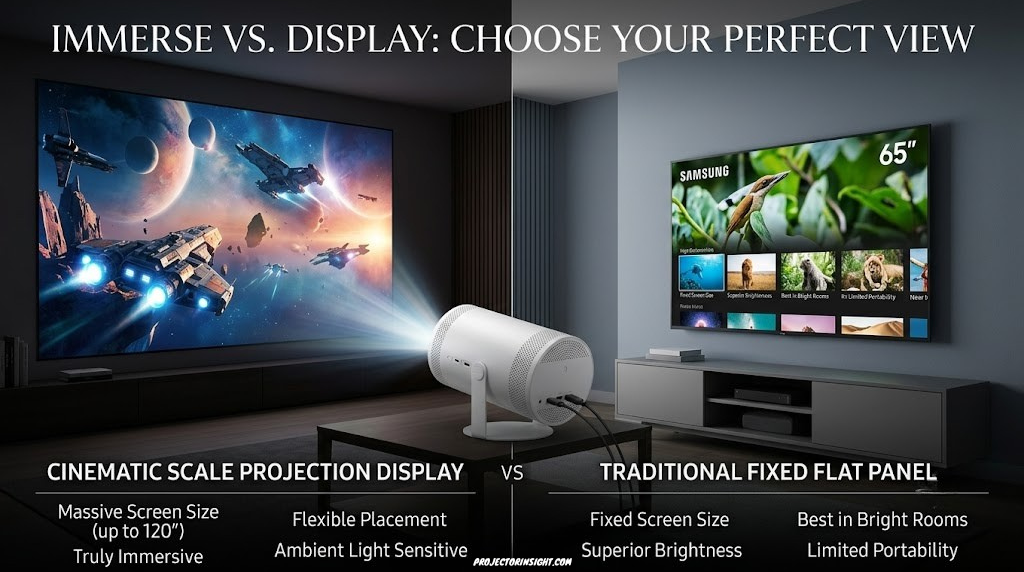
According to imaging standards established by SMPTE (Society of Motion Picture and Television Engineers) and THX, the optimal viewing angle for an immersive cinematic presentation rests between 36 degrees and 50 degrees of your total horizontal field of view. Achieving a 40-degree field of view with an 85-inch television requires a strict seating distance of approximately 8.7 feet. If your architectural space mandates a seating distance of 12 to 14 feet, an 85-inch television shrinks relative to your vision, dropping below immersive theater standards. Conversely, a projection array allows users to easily customize and adapt the total image footprint to match spatial constraints, scaling seamlessly upward via the internal optical assembly to maintain a precise, certified field of view across multiple tiers of home theater seating.

Maximize Your Field of View Immersion
Unlock absolute visual domination with premium projection options designed to deliver authentic theater scale right to your walls.
Shop Giant Screens on Amazon3. Image Quality Face-Off: Native Resolution, Sharpness, and Pixel Density
While projection dominates the spatial scale paradigm, direct-view televisions retaliate strongly within the realms of pixel density and structural acuity. An 85-inch television boasting a native 3840×2160 Ultra HD resolution layout packs an impressive level of sharp pixel concentration—yielding roughly 51.8 Pixels Per Inch (PPI). This high concentration means viewers can sit exceptionally close to the panel without ever witnessing the underlying pixel structure, pixel gaps, or jagged edges. The image remains perfectly sharp and smooth, rendering fine structural details like individual strands of hair, garment weaves, and background text with absolute, unyielding clarity.
Projection systems take a fundamentally different path to achieve Ultra HD rendering. While select ultra-premium residential models utilize true, native 4K imaging chips, the majority of consumer-facing models employ high-speed pixel-shifting techniques. By pairing a native 1920×1080 or 2716×1528 chip architecture with a hyper-fast optical refractor that shifts the light path diagonally at microsecond frequencies, they effectively superimpose overlapping pixels to draw 8.3 million individual addresses on the screen canvas. While this technique passes rigorous CTA definition standards for 4K imagery, the structural pixel borders can blur slightly when cast across a massive 120-inch or 150-inch fabric screen canvas, reducing the absolute perceived spatial sharpness when inspected from close proximity.
Furthermore, standard projection setups are heavily dependent on optical focus lenses. Budget lenses can introduce subtle chromatic aberrations and soft corners along the perimeter of your projection boundary. A direct-view television panel completely bypasses these optical focus hurdles; its sub-pixels are hard-wired directly to the underlying matrix substrate, ensuring uniform edge-to-edge convergence and absolute pixel geometry from the dead center of the screen to the furthest structural corners of the display panel frame.

Discover True Ultra-HD Precision Optics
Experience pristine pixel fidelity and uncompromising edge-to-edge clarity with hand-selected, high-performance display hardware.
View 4K Optics on Amazon4. Brightness, Ambient Light Resistance, and Contrast Realities (Nits vs. ANSI Lumens)
To accurately compare the optical performance of these competing options, one must understand the distinct units of light measurement used by each system. Televisions calculate luminance output directly from the emissive screen surface using **Nits** (candelas per square meter). Projection engines calculate the total luminous flux emitting from the projection lens assembly using ANSI Lumens. This fundamental difference in light path design dictates how each system interacts with the ambient light inside your viewing space.
An 85-inch television operates as a direct-view, self-contained emissive panel. Modern Mini-LED or high-output Quantum Dot displays routinely pump out steady light profiles ranging from 1,000 Nits to well over 2,500 Nits on a full-screen window. Because the light shoots directly out from the panel surface into your pupils, it easily overpowers competing ambient light streaming in from open windows or overhead light fixtures. This allows televisions to preserve rich, deep black levels alongside blinding highlights in sun-drenched multi-purpose living rooms.
Projectors utilize a reflective model: light leaves the chassis lens, travels across open airspace, strikes a screen fabric, and then bounces back toward your eyes. During this open-air journey, any ambient light present in the room will strike the screen surface as well, washing out the image. Because standard white projector screens cannot differentiate between ambient room light and projector light, they bounce everything back simultaneously. In a room with white walls or unmanaged windows, the black levels of your image are instantly ruined, reducing your dynamic range to an uninspired, flat, grey wash.
| Display Technology Type | Average Peak Brightness Range | Optimal Room Lighting Condition | Black Level Floor Integrity |
|---|---|---|---|
| Direct-View LED / Mini-LED TV | 1,500 – 3,000 Nits | High Ambient Light / Windows Open | Excellent (Local Dimming Zero-Level) |
| OLED Television | 800 – 1,500 Nits | Controlled to Moderate Light | Absolute Perfect (Infinite Contrast) |
| Ultra-Short-Throw (UST) Laser | 2,500 – 4,000 ANSI Lumens | Moderate Ambient (Requires ALR Screen) | Good to Very Good |
| Standard Long-Throw Projector | 1,500 – 3,000 ANSI Lumens | Dedicated Dark Room / Blacked Out | Highly Dependent on Ambient Light Control |
To mitigate this optical physics vulnerability in brighter environments, specialized setups require deploying a highly advanced ALR screen for UST projector engines. Ambient Light Rejecting screens utilize micro-replicated triangular prism structures designed to actively swallow ambient light arriving from overhead angles, while reflecting light arriving from the ultra-short throw projector sitting directly below into your viewing seats. While this combination narrows the performance gap, it still struggles to rival the unyielding, high-nit peak contrast punch and deep black levels provided natively by an emissive Mini-LED or self-lit OLED television panel.

Conquer Ambient Light Challenges
Explore specialized high-lumen laser systems and optical ambient light rejecting screens engineered to maintain rich contrast in any room environment.
Shop High-Bright Projectors on Amazon5. Color Accuracy, High Dynamic Range (HDR10, Dolby Vision), and Gamut Performance
True cinematic presentation depends heavily on rendering an expanded color palette and managing micro-step luminance gradations. This performance vector is governed by High Dynamic Range (HDR) profiles, such as HDR10, HDR10+, and the frame-by-frame metadata of Dolby Vision. Implementing authentic HDR processing requires an display ecosystem capable of simultaneous, wide-ranging shifts between near-zero black zones and brilliant highlight peaks.
Direct-view televisions excel at HDR rendering. Premium 85-inch options utilize Full Array Local Dimming (FALD) arrays containing thousands of miniature LED zones or self-emissive OLED sub-pixels that turn completely off on an individual basis. This allows a television to display a deep space scene with perfect, zero-nit black levels right alongside a blazing spaceship engine outputting 2,000 Nits. This immense intra-frame contrast ratio allows colors within the DCI-P3 and BT.2020 spaces to retain intense, realistic saturation across all brightness steps.
Projection systems approach HDR content with structural limitations. Because a projector can never throw a color darker than the resting shade of the screen fabric it hits, its minimum black level floor is fundamentally restricted. To compensate for this, projection systems use internal dynamic tone mapping algorithms. These algorithms intercept the high-nit HDR signal and intelligently compress the master luminance curve to fit within the lower physical capabilities of the projector optics.
Fortunately, color depth itself remains a major strength for high-end laser systems. Multi-color, triple-laser light engines (RGB Pure Laser) bypass standard phosphor wheels entirely, utilizing discrete red, green, and blue laser diodes to construct pure monochromatic light streams. This advanced engineering allows modern 4K laser projectors to easily cover 100% of the ultra-wide BT.2020 color space. This results in incredibly pure, rich color rendering that often matches or surpasses the color spaces of standard commercial movie theaters, even if the absolute peak contrast punch is softer than a premium direct-view TV.

Experience Rich, Pure Triple-Laser Colors
Indulge in absolute color precision with high-end RGB triple-laser projection hardware that covers the wide BT.2020 cinema color spaces.
Explore Laser Systems on Amazon6. Gaming Capabilities: Refresh Rates, Input Lag, and Interface Standards
For modern interactive entertainment, a display must act as a lightning-fast, ultra-low-latency command portal. The performance vectors here are strictly defined by millisecond input responses, variable refresh sync technologies, and interface bandwidth capacities. Direct-view televisions have spent years optimizing for these specific gaming demands, and they currently hold a technical lead in this space.
An elite 85-inch television comes standard with full-bandwidth HDMI 2.1 input ports. This massive data pipeline allows the panel to digest a native 4K signal at a hyper-smooth 120Hz or 144Hz refresh rate, carrying full 4:4:4 chroma sampling alongside modern Variable Refresh Rate (VRR) protocols like AMD FreeSync Premium Pro and NVIDIA G-Sync. Input lag measurements on premium gaming televisions routinely drop below 10 milliseconds, delivering instantaneous real-time response that meets the demands of high-stakes competitive gaming.
“For ultra-fast multiplayer tracking and competitive frame rates, HDMI 2.1 bandwidth remains an essential system prerequisite.”
Historically, projection systems suffered from sluggish video processing pipelines, generating frustrating input latencies that exceeded 50 to 80 milliseconds. However, a specialized generation of 4K 120Hz gaming projectors has significantly closed this performance gap. By embedding high-speed DLP controller chipsets and dedicated low-latency bypass modes, these specialized gaming projectors can cut input lag down to an impressive 4.2 milliseconds when running at a fast 1080p 240Hz refresh rate, or roughly 16 milliseconds when outputting at a sharp 4K 60Hz resolution. While native 4K 120Hz inputs are increasingly supported on modern long-throw and short-throw variants, true hardware-level VRR processing remains rare in the projection landscape. If your priority centers around competitive, twitch-reflex console or PC gaming, the direct-view television panel remains the superior ultra-low latency standard.
Upgrade to High-Refresh Gaming
Eliminate screen tearing and conquer input lag with advanced, low-latency display units optimized for modern high-performance consoles.
Find Gaming Displays on Amazon7. Installation Architecture, Space Constraints, and Room Ergonomics
The practical realities of installing these systems can dramatically alter the scope of your media room project. An 85-inch television is an immovable, heavy structural object. Weighing anywhere from 90 to over 130 pounds, it requires heavy-duty wall mounting brackets attached to solid structural wall studs, or an expansive piece of media furniture capable of supporting its wide footprints. Its physical dimensions are completely fixed; you cannot fold it away or shrink it when it is turned off. It stands permanently as a massive, glossy black mirror dominating your room’s interior design.
Projection architecture offers incredible physical flexibility, splitting your layout duties into two distinct components: the compact projector chassis and the specialized screen surface. If you choose a standard long-throw layout, you must carefully navigate structural formulas, utilizing a reliable projector throw distance calculator to ensure your projector sits at the precise distance required to accurately fill your target screen width. You must also run long, in-wall HDMI cables and mount the hardware securely, often requiring you to learn how to mount a projector to a ceiling.
If ceiling structural work or long cable runs are not feasible for your space, ultra short throw projectors present an elegant alternative. These specialized systems sit directly beneath your wall screen on a standard low-profile media console, throwing an immersive 120-inch image from just inches away from the wall. This completely eliminates the risk of shadows blocking the image when someone walks across the room.
For multi-use living areas where a massive screen might clash with the decor, you can combine a projector with a motorized, drop-down screen that retracts flush into the ceiling at the touch of a button, completely restoring your room’s aesthetic clean lines in seconds.

Deploy a Stealth Cinema Array
Explore flexible ultra-short throw models and low-profile motorized screens designed to blend seamlessly into your interior design.
Shop UST Projectors on Amazon8. Sound Systems, Acoustic Engineering, and Integrated Audio Limitations
True entertainment immersion requires an audio experience that matches the scale of the visuals. Unfortunately, built-in factory audio solutions across both formats are inherently limited by physics. An 85-inch television features an ultra-thin frame that leaves almost no internal physical volume for proper speaker cabinets. While manufacturers employ clever processing tricks and small tracking transducers behind the panel, the resulting sound profile is thin, lacks meaningful bass response, and fails to deliver directional acoustic impact.
Projector enclosures face a different set of audio challenges, primarily driven by thermal management. Housing high-output laser arrays or bright projection lamps generates significant heat, requiring internal cooling fans to run continuously. In quiet cinematic moments, a cheap projector’s fan noise can become a distracting buzz right above your head. While high-end ultra-short-throw models leverage their larger chassis size to include respectable built-in soundbars engineered by premium audio brands, they still cannot replicate a true multi-channel surround sound experience.
A major advantage of projection configurations is their compatibility with authentic, theater-grade acoustic layouts. By pairing your projector with an **Acoustically Transparent (AT)** projection screen, you can mount your dedicated left, right, and center channel speakers directly behind the screen fabric, utilizing micro-perforated or woven textiles. This layout mirrors commercial cinema design, ensuring dialogue tracks and directional sound effects map directly to the actors’ lips and on-screen action for absolute spatial accuracy. This advanced layout is physically impossible with a solid, direct-view television panel, which forces users to place their center channel speakers either well below or far above the massive 85-inch frame.

Match Massive Visuals With True Theater Sound
Complete your home theater transformation with premium multi-channel audio equipment and acoustically transparent screens.
Explore Audio Options on Amazon9. Longevity, Maintenance Overhead, Degradation Curves, and Power Efficiency
Investing in a high-end display hub requires evaluating its long-term reliability, maintenance needs, and performance degradation curves over years of operation. The primary point of failure and wear shifts dramatically based on the internal illumination components powering your chosen display platform.
Traditional projection configurations relied on ultra-high-pressure mercury lamps that suffered from rapid, steep performance decay curves. These traditional lamps typically lost up to 50% of their maximum brightness within 2,000 to 4,000 hours of active use, requiring regular, costly bulb replacements to keep the image from looking dull and washed out. Modern buyers can avoid this headache by selecting a model from the superior generation of solid-state laser vs lamp projector engines. Laser light sources deliver an exceptional operating lifespan of 20,000 to 30,000 hours of maintenance-free performance, running at full brightness without requiring bulb changes. However, projectors remain susceptible to dust accumulation inside the optical assembly; if dust breaches the housing, it can create distracting optical artifacts or “dust blobs” on your screen unless the model features a fully sealed optical engine block.
Direct-view televisions offer incredible structural longevity and minimal maintenance requirements. The solid-state LED backlights inside Mini-LED and QLED models are engineered to run for roughly 60,000 to 100,000 hours before dropping to half-brightness, completely bypassing routine maintenance protocols. OLED alternatives do face a small risk of permanent image retention (“burn-in”) if forced to display static station logos or bright video game HUD elements continuously at maximum brightness, though modern internal refresh algorithms have significantly minimized this vulnerability.
From an energy perspective, an 85-inch television drawing a bright HDR image can be quite power-hungry, often pulling between 300 to over 500 Watts of electricity depending on the backlight intensity. A laser projector engine remains remarkably power-efficient relative to the sheer scale of the image it creates, maintaining a stable power draw profile between 200 and 400 Watts while delivering a screen canvas nearly twice the size of a standard television panel.
Invest in Zero-Maintenance Laser Power
Upgrade your configuration with advanced, long-life solid-state laser projection systems engineered for decades of daily cinematic enjoyment.
Shop Laser Systems on Amazon10. Financial Analysis: Initial Capital Expenditure vs. Long-Term Cost per Inch
Evaluating the financial commitment of these display platforms requires looking past the initial price tag on the retail box. True financial analysis means calculating the *Cost-Per-Square-Inch* of viewable display area, while factoring in mandatory secondary companion components that are essential for each path.
An 85-inch television operates as a complete, self-contained functional system out of the box. Your initial investment buys the screen panel, the internal tuner, the smart streaming operating system, and a basic table stand. Mass-production efficiencies have driven down the cost of entry for large flat panels, allowing buyers to secure high-performance 85-inch options at very reasonable price points. For a mid-tier flat panel investment, your cost works out to a modest value per square inch of entertainment canvas.
Projection packages require a different approach to budgeting, as the projector chassis itself is only half of the required imaging ecosystem. Projecting an elite image onto a bare plaster wall can introduce surface texturing, uneven reflections, and color shifts that degrade performance. To maximize your projector’s performance, you must budget for a high-quality fixed-frame or motorized screen, which adds to your initial project costs.
When creating a premium setup in a room with uncontrolled lighting, pairing an advanced short throw chassis with a specialized ambient light rejecting screen pushes your initial entry price higher than a standalone 85-inch TV. However, if your room allows for a massive 130-inch to 150-inch screen size, the value proposition shifts dramatically. Trying to buy a direct-view television larger than 98 inches requires moving into ultra-premium, low-volume manufacturing territory, where retail prices skyrocket rapidly. For ultra-large screen installations, a high-quality projection setup delivers unmatched value, serving as the only cost-effective way to achieve true cinematic scale in the home.

Compare Full Cinematic Packages
Analyze premium high-value display configurations side-by-side to secure the absolute maximum screen area for your budget.
Check Bundle Prices on Amazon11. Pros and Cons Matrix: Comprehensive Breakdown for Both Technologies
To help visualize these trade-offs, this comparative section isolates the distinct structural benefits and performance limits inherent to both display platforms.
- Massive spatial scaling capabilities (100-inch up to 150-inch+ effortlessly)
- True, authentic cinematic immersion mimicking commercial theater environments
- Reflected light paths reduce eye strain during extended night viewing sessions
- Highly flexible installation footprints with retractable stealth screen options
- Acoustically transparent screens allow hidden speaker placement directly behind images
- Highly vulnerable to image washout from ambient room light
- Requires separate investment in a matching screen for optimal performance
- Lower peak HDR highlight brightness compared to high-nit TVs
- May introduce audible fan noise during quiet scenes
- Incredible peak brightness levels (1500+ Nits) that easily overpower bright day room light
- Perfect, native 4K pixel sharpness with exceptional pixel density (PPI)
- Uncompromised HDMI 2.1 gaming platforms with true VRR and sub-10ms input lag
- Simple, self-contained installation requiring no secondary screen purchases
- Absolute black levels and intense intra-frame contrast on premium panels
- Screen size is permanently fixed and cannot be scaled up for larger rooms
- Heavy physical footprint (90-130+ lbs) complicates wall mounting and logistics
- Large, highly reflective glass panel acts as a dark mirror when powered off
- Forces center channel speakers to be placed completely outside the image frame

Acquire Your Ideal Display Solution
Choose the optimal platform that matches your room lighting, gaming habits, and desires for large-screen cinematic scale.
Shop Verified Displays on Amazon12. Ultimate Verdict: Strategic Buying Framework and Recommendations
Choosing between a modern projection system and an 85-inch television ultimately depends on the physical layout and lighting conditions of your room, as well as your primary viewing habits. Both paths offer exceptional, high-fidelity experiences, but they are engineered to excel in completely different environments.
The **85-inch television** is the ideal choice for bright, multi-purpose living spaces, open-concept floor plans, and dedicated gaming setups. If your room features unmanaged windows, bright daylight, or light-colored walls, a premium high-nit television delivers the contrast, brightness, and color saturation needed to keep the image looking sharp and vibrant. It is also the premier platform for competitive gamers who want to maximize the performance of modern consoles with low-latency HDMI 2.1 features, high refresh rates, and variable refresh synchronization.
The **projector configuration** remains the undisputed king for dedicated home theaters, dark media rooms, and movie enthusiasts who refuse to compromise on true cinematic scale. If you want a screen that exceeds 100 to 120 inches to recreate a genuine commercial theater experience, projection is the only practical, cost-effective way to achieve that level of immersion. By pairing a high-end laser projector with an appropriate screen, you can create a breathtaking, large-scale visual environment that transforms movie nights into unforgettable events.
To pick the perfect path for your home, start by mapping out your room’s physical dimensions and light control capabilities, then match those factors against your lifestyle needs and installation budget. Whichever technology you choose, investing in modern high-performance display hardware is a fantastic way to elevate your home entertainment and build an incredible space for family and friends to enjoy for years to come.

Build Your Masterwork Home Theater Today
Take control of your home entertainment destiny. Order top-tier, field-tested projectors, televisions, and cinema accessories.
Finalize Your Theater Setup on AmazonFrequently Asked Questions (FAQ)
Can an ultra-short-throw projector fully replace a standard living room television?
Yes, an ultra-short-throw laser projector can replace a living room TV, provided it is paired with a matching Ambient Light Rejecting (ALR) screen. While it can handle moderate room light well, it may still look slightly less vibrant than a direct-view television in intense, direct daylight.
How long do modern laser projector systems last before losing performance?
Modern solid-state laser projectors are typically rated to last between 20,000 and 30,000 hours of active use before experiencing meaningful brightness decay. This eliminates the need for routine bulb replacements, providing decades of reliable daily operation.
Is it possible to project a high-quality image directly onto a standard white wall?
While you can project onto a flat wall, it is not recommended for a premium home theater setup. Bare walls often have subtle surface textures, imperfections, and color casts that can blur fine details and reduce image contrast compared to a dedicated projector screen.
Why do direct-view televisions handle HDR content better than home projectors?
Televisions excel at HDR content because they use individual local dimming zones or self-emissive pixels to produce deep black levels right next to bright highlights. Projectors are limited by the base color of the screen fabric, meaning they rely on tone-mapping algorithms to adapt high-contrast HDR highlights into a narrower physical range.
Do home theater projectors produce distracting fan noise during operation?
Most home theater projectors require internal cooling fans to manage the heat from their bright light sources. High-end models keep this fan noise remarkably quiet (often under 26-30 dB), making it barely noticeable unless you are sitting directly next to the chassis during a completely silent scene.
Which option is better for competitive console gaming on PS5 or Xbox Series X?
An 85-inch television with full HDMI 2.1 support is generally superior for competitive gaming. It offers native 4K resolution at 120Hz, ultra-low input lag (sub-10ms), and variable refresh rate (VRR) support. While specialized gaming projectors perform well, they rarely offer full hardware-level VRR processing.
What is an acoustically transparent screen, and why is it beneficial?
An acoustically transparent screen uses a specialized woven or micro-perforated fabric that allows sound waves to pass right through it. This allows you to mount your front and center speakers directly behind the screen, matching the audio perfectly with the on-screen action just like a commercial cinema.
Are ultra-large screens prone to causing more eye strain over long viewing sessions?
Projector screens generally cause less eye strain because they use a reflected light path, where light bounces off the screen before entering your eyes. Televisions use a direct-view emissive light path that fires light directly at your pupils, which can feel more fatiguing during extended viewing in a dark room.
Is an 85-inch television screen larger than a 100-inch projection screen?
No, a 100-inch projection screen provides roughly 39% more viewable surface area than an 85-inch television. Screen sizes are measured diagonally, meaning small increases in the diagonal measurement result in substantial jumps in total screen real estate.
Are home theater projectors difficult to install and set up correctly?
Standard long-throw projectors require careful positioning, precise throw distance calculations, and secure mounting. If you prefer a simpler installation, ultra-short-throw projectors sit directly beneath your screen on a standard media console, offering an easier path to a massive screen experience.