
The Best 3D Home Cinema Projectors: Immersive Picture, Every Budget
3D projection is back on enthusiasts’ radars — and the latest generation of projectors does it properly. This guide covers the best hardware for genuine home cinema 3D, from value-priced performers to reference-grade flagships.
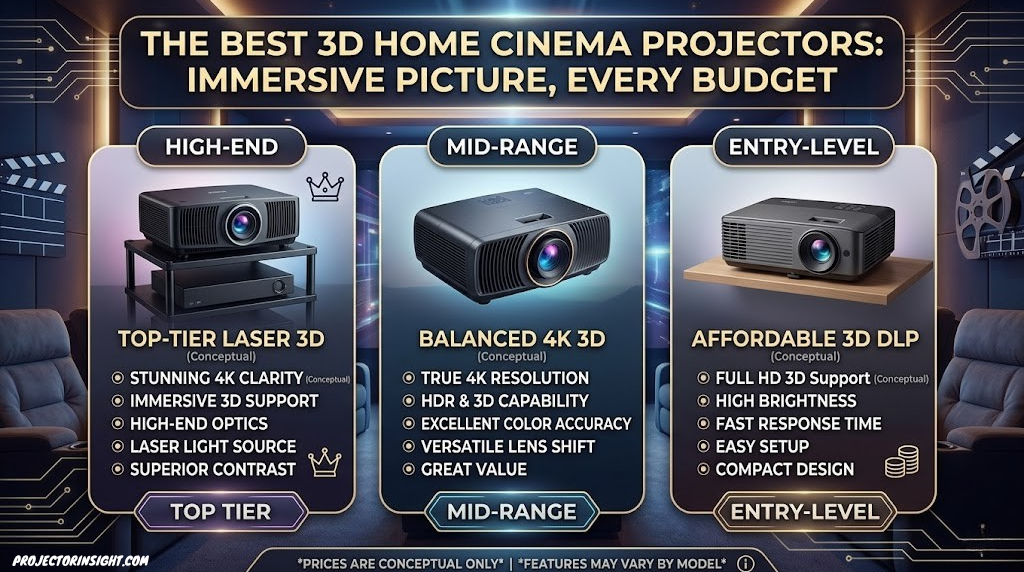
Active shutter 3D on a 120-inch screen remains one of the most immersive experiences home entertainment can deliver — when the projector handles it correctly.
Why 3D Home Cinema Still Matters — And Who It’s For
Mainstream 3D television quietly faded from living room consciousness a few years ago. But in dedicated home cinema rooms, active shutter 3D projection never disappeared — and the quality of the experience on a proper 100-inch or larger screen remains something no 3D television ever came close to replicating.
The case for 3D projection begins with scale. Active shutter 3D on a 50-inch television was always a slightly diminished experience — the glasses dimmed the image, the screen felt too small for the effect to fully land, and the whole setup felt like a gimmick rather than a revelation. On a 110-inch projected image in a dark room, the same 3D content becomes genuinely immersive. Depth feels real. Objects that protrude toward the viewer create genuine spatial surprise. It’s the format cinema directors intended when they mastered these films, and it requires a projector and screen to reproduce at the scale where it was designed to work.
The 3D Blu-ray library is also more extensive than many people realize — thousands of titles spanning action, animation, documentary, and concert formats, with many of the most visually stunning films ever produced available in the format. As long as you have a 3D Blu-ray player and a capable projector, the content ecosystem is not a limiting factor.
This guide is aimed at home cinema enthusiasts who want 3D as a genuine primary feature alongside excellent 2D performance — not as an afterthought checkbox on a spec sheet. Every projector covered here has been evaluated on its actual 3D picture quality, 3D brightness retention, crosstalk performance, glasses compatibility, and 2D picture quality in equal measure. For a broader perspective on what to consider before any projector purchase, our guide on how to choose a projector provides a useful foundation to build from.
How Home Cinema 3D Projection Actually Works
Home cinema projectors use frame-sequential 3D: the projector outputs alternating left-eye and right-eye frames at 120Hz (60 frames per second for each eye). Active shutter glasses receive a synchronization signal — usually infrared — and alternate which lens is transparent in perfect sync with the projector. Your brain combines the slightly offset left and right perspectives into a single three-dimensional image, creating the illusion of depth.
The key technical requirements for this to work properly are: a projector that outputs at 120Hz in 3D mode, a fast enough switching speed in the imaging chip to avoid ghosting between frames, active shutter glasses that match the projector’s synchronization protocol, and a 3D source (typically a 3D Blu-ray player) connected via HDMI 1.4.
Why Brightness Matters More in 3D
Active shutter glasses work by blocking each eye alternately — which means each eye receives light for only half the time. On top of that, the tinted lenses absorb additional light. The combined effect is typically a 50 to 70 percent reduction in perceived brightness compared to 2D. A projector rated at 2,000 lumens delivers effectively 600–1,000 lumens in 3D. This is why brightness is the first specification to scrutinize for 3D performance — it matters far more here than in 2D viewing. Understanding the full context of brightness claims requires reading our detailed guide on what ANSI lumens actually measure before interpreting manufacturer figures.
Crosstalk: The Quality Killer to Watch For
Crosstalk is the most common 3D image quality problem: it occurs when light meant for one eye bleeds into the other eye’s frame, creating a ghost image on high-contrast edges. At best, it’s a minor distraction. At worst, it causes eye strain and ruins the immersive effect entirely. It’s caused by slow phosphor decay in the projector’s light path, imprecise glass timing, or high screen gain creating reflections. The projectors on this list have been selected in part for their low crosstalk performance — DLP models generally excel here due to their fast switching nature, while good 3LCD models like the Epson 5050UB have been specifically engineered to minimize it.
What to Look For in a 3D Home Cinema Projector
Minimum 2,500 Lumens for Usable 3D Brightness
Given the 50–70% brightness penalty from active shutter glasses, any 3D projector you’re serious about should produce at least 2,500 ANSI lumens in its brightest 2D mode. Below that, 3D viewing on screens larger than 100 inches becomes dim even in a dark room. The projectors on this list range from 2,200 to 4,000 lumens in 2D, giving effective 3D brightness of approximately 660 to 2,000 lumens depending on the specific unit and glass type.
Frame Rate: 120Hz Native or 3D Processing
For frame-sequential 3D, the projector must output at 120Hz in 3D mode — 60 frames per second for each eye. All projectors on this list support this. The underlying panel or chip technology determines how cleanly this switching occurs: DLP’s digital mirror approach switches states faster than most LCD implementations, giving it a structural advantage for 3D frame separation.
DLP vs. 3LCD for 3D
DLP projectors are generally considered the superior choice for 3D, with fast switching speed and a design that produces cleaner frame separation and lower crosstalk. Single-chip DLP’s fast response minimizes ghosting on high-contrast 3D edges. However, 3LCD projectors like the Epson 5050UB have addressed this through careful engineering and produce excellent 3D with much better color brightness in 3D mode than equivalent DLP models — since 3LCD’s color brightness matches its white brightness, the 3D image retains more color depth. Our full comparison of 3LCD vs. DLP projector technologies covers this trade-off in depth.
Glasses Compatibility
Active shutter glasses must be compatible with the projector’s synchronization protocol. Most projectors use a proprietary infrared emitter that requires either the manufacturer’s own glasses or certified third-party alternatives. Glasses cost $30–$80 per pair when purchased separately. If you need multiple pairs for family viewing, verify the cost and availability of compatible glasses before purchasing the projector.
4K vs. 1080p for 3D Content
There is no 4K 3D Blu-ray format — all 3D Blu-ray content is 1080p resolution. A 4K projector displaying 3D Blu-ray will render it at 1080p. The argument for a 4K projector in a 3D context is that the same projector will deliver 4K resolution for all your 2D content, which represents the majority of viewing time. Our guide to the best 4K laser projectors covers the 4K landscape specifically for viewers who want 4K as the primary capability.
Quick Picks: Best 3D Projectors at a Glance
Epson HC 5050UB
3LCD with superb color brightness in 3D, reference contrast
BenQ HT4550i
4K DLP with low crosstalk and ISF certification
Optoma UHD38x
4,000 lumens — brightest 3D image on this list
Epson HC 3800
Pixel-shift 4K with excellent 3D color at mid-range price
BenQ TK700STi
4K short-throw with low lag and Android TV
Optoma UHD55
Quiet DLP with good 3D and strong contrast
BenQ HT3560
Affordable 4K DLP entry with solid 3D handling
1. Epson Home Cinema 5050UB — Best Overall 3D Home Cinema Projector
Epson Home Cinema 5050UB

The Epson Home Cinema 5050UB is the projector that consistently appears at the top of enthusiast 3D recommendations, and the reasons are structural rather than arbitrary. Its 3LCD design — three separate panels for red, green, and blue — means color brightness in 3D mode matches white brightness. On most DLP projectors, the rotating color wheel creates a gap between white brightness and color brightness; the 3D image can look bright overall but washed-out in color. The 5050UB’s 3D images retain the full color saturation of the source content, making the experience noticeably more vivid and cinematic.
The inclusion of two pairs of RF active shutter glasses out of the box makes the out-of-box experience significantly better than competitors that charge extra for glasses. RF synchronization is more reliable than infrared — it doesn’t require line-of-sight with the projector and works at greater angles, which matters when you’re reclined in a home theater seat.
Beyond 3D, the 5050UB’s 2D picture quality is among the best available at its price: the motorized lens with full horizontal and vertical lens shift makes real-room installation flexible, the dynamic contrast system delivers deep blacks in dark scenes, and HDR10 handling is calibrated rather than simply tone-mapped. It also supports 3D content through its HDR processing pipeline, giving 3D Blu-ray content the benefit of proper contrast and color management rather than a generic 3D-on mode. This is also one of the projectors featured in our best home theater projectors roundup for its overall picture performance.
Strengths
- 3LCD delivers better color brightness in 3D vs. DLP
- Includes 2 RF shutter glasses in the box
- Motorized lens with full H+V lens shift
- Outstanding 2D picture quality
- Minimal crosstalk with proper calibration
- HDR10 and HLG support
Limitations
- 3D available on 1080p content only (no 4K 3D exists)
- No built-in smart TV platform
- Large physical footprint
- Premium price point for the category
Epson Home Cinema 5050UB — Best 3D color brightness, RF glasses included, motorized lens. The reference 3D home cinema projector.
Check Price on Amazon2. BenQ HT4550i — Best 4K DLP 3D Projector
BenQ HT4550i

BenQ’s HT4550i brings ISF (Imaging Science Foundation) certification to the 4K DLP category — meaning it ships with pre-calibrated ISF Day and ISF Night picture modes validated by professional calibrators, allowing buyers without access to a professional calibration service to start with a baseline that’s close to industry-standard picture accuracy. For 3D content, the calibrated color processing ensures the 3D image doesn’t look artificially boosted or desaturated compared to properly graded source material.
DLP’s structural advantage for 3D comes through clearly in the HT4550i’s 3D performance: crosstalk is among the lowest in the class, high-contrast 3D scenes — particularly bright objects against dark space in action or sci-fi content — maintain clean edges without the ghosting artifacts that affect some LCD-based 3D projectors. At 3,200 lumens in 2D mode, the 3D image retains meaningful brightness even on larger screens.
The HT4550i’s Android TV integration via a built-in dongle provides streaming access including support for most major platforms, and its 2D picture quality is competitive with the best in its price range. For buyers who prioritize clean 3D performance and ISF-calibrated color accuracy in a DLP package, this is the reference choice. It’s also featured in our guide to high-end home cinema projectors for its calibration and picture quality pedigree.
Strengths
- DLP minimizes 3D crosstalk naturally
- ISF certified — factory-calibrated color modes
- 3,200 lumens — good 3D brightness reserves
- 4K pixel-shift for excellent 2D sharpness
- Android TV built-in dongle
Limitations
- DLP-Link glasses not included — must be purchased
- No lens shift — requires precise physical placement
- Single-chip DLP color brightness lower than 3LCD in 3D
BenQ HT4550i — ISF-certified 4K DLP with low crosstalk 3D, 3,200 lumens, and Android TV. The DLP benchmark for home cinema 3D.
Check Price on Amazon3. Optoma UHD38x — Best Brightness for 3D on Larger Screens
Optoma UHD38x

The Optoma UHD38x’s defining characteristic is its 4,000-lumen brightness — 54% more than the Epson 5050UB in 2D mode. In 3D mode, where brightness is the limiting factor for image impact, this headroom pays off in a way that’s immediately visible: 3D images on a 120-inch or larger screen retain punch and depth that dimmer projectors lose. Dark 3D scenes in space films or night sequences in action movies stay visually compelling rather than muddy and grey.
The UHD38x was designed with enhanced low-latency mode (4.2ms) for gaming applications, which also benefits 3D content by ensuring the frame-sequential output is precisely timed to the active shutter glasses with minimal lag. For rooms with longer throw distances or screens at the upper end of the typical home cinema range (120–150 inches), the UHD38x’s brightness reserve is the most practical solution to the 3D dimming problem without moving to commercial-grade projectors. See our guide to projectors for bright rooms for more on what brightness headroom means in practice.
Strengths
- 4,000 lumens — best-in-class 3D brightness
- Low crosstalk via DLP design
- Enhanced low-latency mode for 3D timing accuracy
- 4K pixel-shift with sharp 2D image quality
- Good for larger 120–150 inch screens
Limitations
- DLP-Link glasses not included
- Less accurate color than ISF-calibrated competition out of the box
- No lens shift — precision placement required
- Fan noise noticeable in high-brightness mode
Optoma UHD38x — 4,000 lumens of 4K DLP brightness for impactful 3D on screens up to 150 inches. The high-brightness 3D solution.
Check Price on Amazon4. Epson Home Cinema 3800 — Best Value 4K 3D Projector
Epson Home Cinema 3800

The Epson HC 3800 occupies the most valuable position on this list: it delivers the core advantages of the 5050UB’s 3LCD 3D performance — matching color brightness in 3D mode, glasses included, full lens shift — at a meaningfully lower price. The trade-off is primarily in some of the 5050UB’s more advanced features: the dynamic contrast system is less sophisticated, and the lens motorization is absent (manual zoom and focus instead). For the picture quality that most viewers actually see, the 3800 gets remarkably close to the 5050UB.
The 3,000-lumen 3LCD output is 400 lumens brighter than the 5050UB in its standard configuration, which translates to slightly better 3D brightness in practice. The wide color gamut coverage makes 3D animated and nature content look vivid and real-world accurate rather than oversaturated or muted. The inclusion of glasses and lens shift at this price point makes the total cost of a 3D-ready home cinema installation noticeably lower than DLP competitors that require additional glass purchases.
For anyone building their first dedicated home cinema and prioritizing 3D as a key feature, the 3800 is the most balanced entry point. Those on a tighter budget should also look at our best projectors under $1,000 guide for context on where the 3800 sits in the wider price landscape.
Strengths
- 3LCD color brightness advantage in 3D
- Includes 2 pairs of 3D glasses
- 3,000 lumens for strong 3D brightness
- H+V lens shift for flexible room placement
- Wide color gamut and HDR10 support
Limitations
- Manual focus/zoom — no motorized optics
- Dynamic contrast less sophisticated than 5050UB
- No built-in smart TV platform
Epson Home Cinema 3800 — 3LCD 3D with glasses included, 3,000 lumens, lens shift. The best-value 3D home cinema projector.
Check Price on Amazon5. BenQ TK700STi — Best for Gaming and 3D Combined
BenQ TK700STi
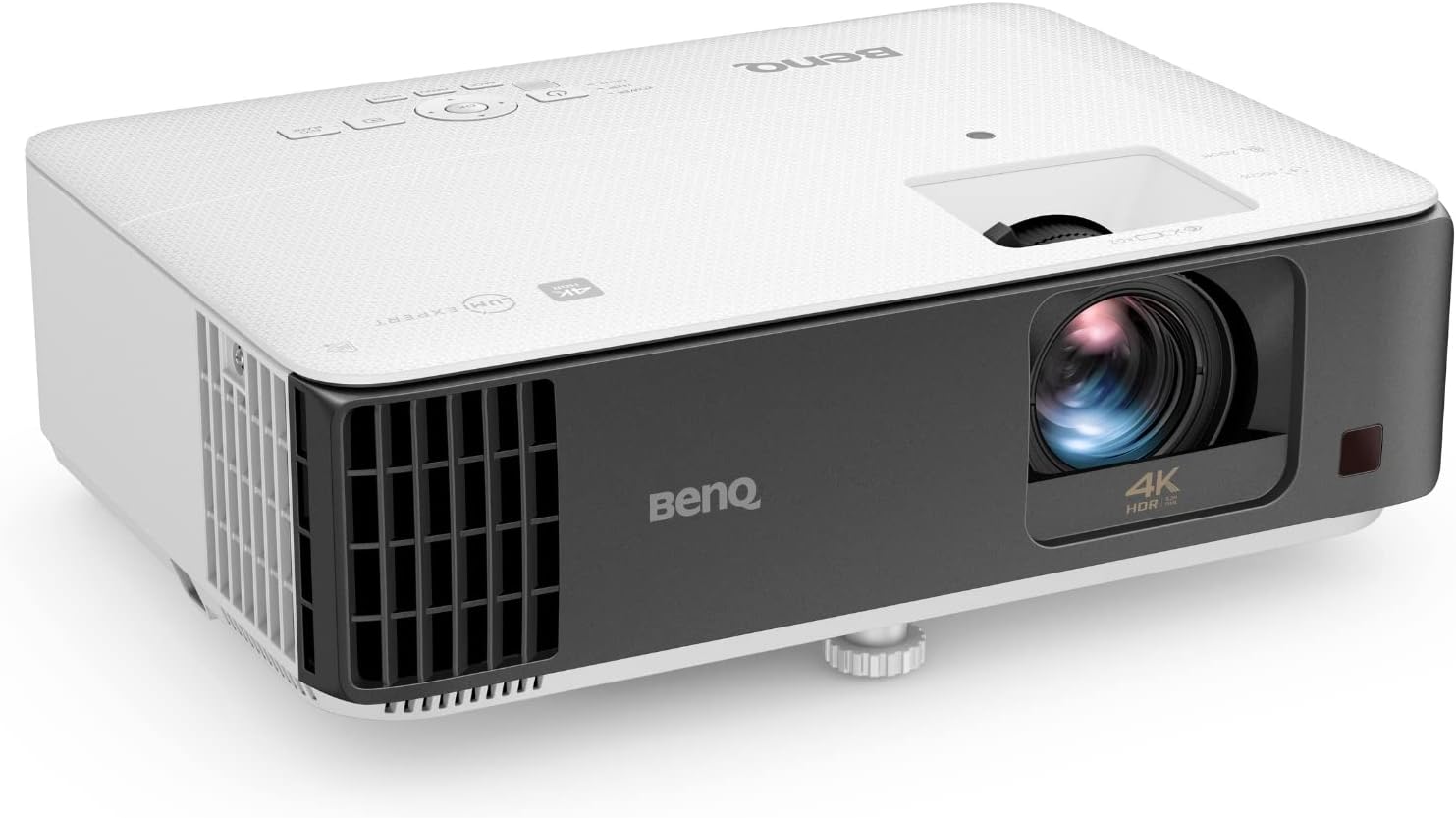
The BenQ TK700STi answers a specific question: what if your room doesn’t have 10–15 feet of depth for a standard-throw projector, but you still want full 4K 3D capability? Its 0.5 throw ratio produces a 100-inch image from approximately 5 feet away — short-throw territory that opens up home cinema options in smaller or more constrainted rooms without going to ultra-short throw pricing. This compares favorably against the full analysis in our UST vs. standard throw projector guide.
The Android TV integration brings streaming apps directly to the projector without an external device, which is convenient for a room setup that doubles as a gaming and cinema space. Gaming-focused features including low-latency modes are also present — at 4K/60Hz, input lag drops to competitive levels for console gaming. The 3D experience benefits from the same DLP fast-switching advantage as the HT4550i and UHD38x. For those specifically pursuing the gaming-and-3D combination, our 4K gaming projector guide covers this dual-use case in depth.
Strengths
- Short-throw 0.5 ratio — large image in small rooms
- DLP clean 3D frame separation
- 3,000 lumens with adequate 3D brightness
- Android TV for integrated streaming
- Good low-lag gaming performance
Limitations
- DLP-Link glasses not included
- No lens shift — limited placement adjustment
- Short-throw optics add cost vs. standard-throw equivalent
- Netflix requires sideload or external stick
BenQ TK700STi — 4K DLP short-throw with Android TV, 3D support, and low gaming lag. Best for rooms with limited depth.
Check Price on Amazon6. Optoma UHD55 — Best Quiet Mid-Range 3D DLP Projector
Optoma UHD55

The Optoma UHD55 makes its case through a combination often overlooked in spec comparisons: it’s one of the quieter high-brightness DLP projectors in its price range. At 28dB operating noise, the UHD55 is significantly less intrusive in a home cinema environment than projectors that reach 33–36dB in their high-brightness modes. For 3D viewing, where the brightness mode is important for compensating for glass dimming, this quiet operation means you can run the projector at higher brightness without the fan becoming part of the soundtrack.
The 3,500-lumen output with 1.6x optical zoom gives the UHD55 placement flexibility that some DLP competitors lack, and the combination of high brightness and low noise makes it a practical choice for rooms where the projector is closer to viewers than is ideal for quieter models. The 4K pixel-shift produces clean, detailed 2D images, and the 3D performance benefits from both the brightness reserve and DLP’s fast switching architecture. See our native 1080p projector guide for comparisons if you’re also considering 1080p options at a lower price.
Strengths
- 28dB quiet operation — no fan intrusion
- 3,500 lumens for strong 3D brightness
- DLP clean 3D frame separation
- 1.6x optical zoom for placement flexibility
- 4K pixel-shift with sharp 2D image
Limitations
- DLP-Link glasses not included
- No lens shift on base model
- No built-in smart TV platform
Optoma UHD55 — 3,500 lumens at 28dB quiet operation. Strong 4K DLP 3D performance without fan noise intruding on the viewing experience.
Check Price on Amazon7. BenQ HT3560 — Best Budget-Friendly 4K 3D Entry
BenQ HT3560

The BenQ HT3560 is the entry point where 4K DLP 3D capability becomes accessible to buyers with more constrained budgets. At 2,000 lumens, it’s the dimmest projector on this list in 3D mode — and that context is important: it needs a properly darkened room and a screen no larger than 100 inches to deliver a satisfying 3D image. In those conditions, the DLP’s clean frame-sequential processing and BenQ’s factory color calibration to Rec.709 and DCI-P3 standards produce a 3D picture that’s accurate, artifact-free, and genuinely cinematic.
The HT3560 includes vertical keystone correction (±30°), which helps compensate for placement that’s slightly below or above the ideal screen center — a meaningful convenience in rooms where ideal projector placement isn’t available. The 4K pixel-shift for 2D content provides sharp, detailed images that compare well against more expensive projectors for everyday viewing. It also receives a mention in our best projectors under $500 category where applicable for budget-focused buyers exploring the 3D space. For the full range of projectors at higher budgets with better 3D brightness, our budget-spanning projector guide provides broader context.
Strengths
- Most affordable 4K DLP 3D entry on this list
- DLP provides clean 3D frame separation
- Factory Rec.709 and DCI-P3 calibration
- ±30° vertical keystone for placement flexibility
- Excellent 2D picture quality for the price
Limitations
- 2,000 lumens — dark room essential for 3D
- Not suitable for 3D on screens above 100 inches
- DLP-Link glasses not included
- No lens shift
BenQ HT3560 — Affordable 4K DLP 3D with Rec.709 calibration. The cleanest entry into 3D home cinema projection for budget-conscious buyers.
Check Price on AmazonFull 3D Projector Comparison Table
Use this table to compare the specifications that matter most for 3D performance across all seven projectors. The estimated effective 3D brightness column applies a conservative 35% multiplier to the rated 2D lumens.
| Projector | Tech | 2D Lumens | Est. 3D Lumens | 3D Glasses | Lens Shift | 4K | Smart OS |
|---|---|---|---|---|---|---|---|
| Epson HC 5050UB | 3LCD | 2,600 | ~910 | RF — Included ×2 | H+V (motorized) | ✓ (PS) | None |
| BenQ HT4550i | DLP | 3,200 | ~1,120 | DLP-Link — extra cost | None | ✓ (PS) | Android TV |
| Optoma UHD38x | DLP | 4,000 | ~1,400 | DLP-Link — extra cost | None | ✓ (PS) | None |
| Epson HC 3800 | 3LCD | 3,000 | ~1,050 | Included ×2 | H+V (manual) | ✓ (PS) | None |
| BenQ TK700STi | DLP | 3,000 | ~1,050 | DLP-Link — extra cost | None | ✓ (PS) | Android TV |
| Optoma UHD55 | DLP | 3,500 | ~1,225 | DLP-Link — extra cost | None | ✓ (PS) | None |
| BenQ HT3560 | DLP | 2,000 | ~700 | DLP-Link — extra cost | None | ✓ (PS) | None |
PS = Pixel-Shifted 4K. Est. 3D lumens calculated at 35% of rated 2D lumens (conservative estimate with active shutter glasses). Actual 3D brightness varies by glasses type and content.
DLP vs. 3LCD for 3D: The Complete Picture
Why DLP Has a Structural Advantage for 3D
DLP projectors use a single chip covered in millions of tiny mirrors that switch between on and off states at extremely high speeds. This fast switching means DLP can change between left-eye and right-eye frames with very little transition time — leaving almost no gap for one eye’s image to bleed into the other’s. The result is low crosstalk — clean, ghost-free 3D edges even on high-contrast content like bright spacecraft against black space or white text over dark backgrounds. This is the DLP structural advantage for 3D, and it’s real and meaningful for certain types of content.
Why 3LCD’s Color Brightness Advantage Matters More in 3D
3LCD projectors use three separate LCD panels — one each for red, green, and blue — which means the color brightness they produce equals their white brightness. On a DLP projector with a color wheel, the wheel spins through color segments sequentially, which means color and white brightness are separated in time. In 2D viewing, this is largely invisible. In 3D viewing, where overall brightness is already reduced by 50–70%, the DLP’s lower color brightness compounds the dimming effect. The 3D image on a 3LCD projector tends to look richer and more saturated at equivalent white brightness levels because the color light isn’t being sacrificed.
Our detailed technical comparison of 3LCD vs DLP projectors covers this trade-off comprehensively beyond the 3D context — it’s worth reading if you’re deciding between technologies across multiple criteria.
The Practical Conclusion
For action, sci-fi, and content with high-contrast 3D elements (bright objects, text, explosions on dark backgrounds), DLP’s low crosstalk is most valuable. For animated content, nature documentaries, and concert films where color saturation defines the 3D experience, 3LCD’s color brightness advantage is most valuable. Both technologies deliver excellent 3D when the projector is well-engineered — the Epson 5050UB proves that a well-designed 3LCD can rival DLP for crosstalk performance while maintaining the color brightness advantage.
Active Shutter Glasses: What You Need to Know Before Buying
RF vs. Infrared Synchronization
Active shutter glasses synchronize with the projector via either infrared (IR) or radio frequency (RF). IR glasses require line-of-sight with the projector’s emitter — if you’re viewing from an angle or reclined, synchronization can drop, causing the 3D effect to fail temporarily. RF glasses operate via Bluetooth-like radio signals that don’t require line-of-sight, work at greater distances, and maintain sync more reliably from different seating positions. The Epson 5050UB uses RF sync and includes RF glasses. DLP-Link projectors use a different approach — the 3D sync signal is embedded in the projected image itself as a flash of light, which the glasses detect optically.
DLP-Link Glasses
DLP-Link is a synchronization system where the projector embeds a flicker of white light between frames that the glasses detect and use to time their shutter. It’s simple and reliable, and any DLP-Link compatible glasses work with any DLP-Link projector regardless of brand. The down side is that the glasses must face the screen to detect the sync signal — turning away from the screen for a moment can lose synchronization. Good DLP-Link glasses from brands like Optoma, BenQ, and Xpand are widely available for $30–$60 per pair.
Cost Per Pair for Family Viewing
If you’re setting up 3D for family or group viewing, budget for multiple pairs of glasses before finalizing your projector choice. The Epson projectors on this list include two pairs of RF glasses — a genuine saving of $80–$120 if you were buying them separately. The DLP projectors require additional glass purchases for more than one viewer, which adds to the total cost of the setup. Calculate the full cost of the 3D experience before comparing projector prices in isolation.
3D Content Sources for Home Cinema
3D Blu-ray: The Primary Source
3D Blu-ray remains the gold standard for home cinema 3D content. The format stores full 1080p resolution for each eye in frame-compatible format on a standard Blu-ray disc, and the library spans thousands of titles including blockbuster films, animated features, nature documentaries, and concert recordings. A standard 3D Blu-ray player (not 4K UHD) is sufficient to play 3D Blu-ray discs — and many 4K UHD Blu-ray players also play 3D Blu-ray, making a single player sufficient for both formats. The player connects to the projector via HDMI 1.4, which is all that’s needed for 3D Blu-ray output.
Side-by-Side and Over-Under 3D Formats
Some 3D content from broadcast, streaming, and media files comes in side-by-side or over-under (top-bottom) formats, where both eye images are compressed into a single frame. Most 3D projectors can decode these formats and convert them to frame-sequential output for the glasses. Picture quality is lower than native 3D Blu-ray because each eye’s image is only half-resolution, but the format is useful for content that isn’t available in full Blu-ray 3D.
Streaming 3D
Major streaming services discontinued native 3D streaming several years ago. Netflix, Disney+, Amazon Prime, and Apple TV+ do not stream 3D content in formats that 3D projectors can use directly. Some niche streaming services and specialized media servers support 3D MVC (Multi-View Coding) format from ripped Blu-ray sources, but this requires a local media server setup. For practical purposes, 3D Blu-ray disc is the most reliable and highest-quality source for home 3D cinema content.
Setting Up Your Projector for the Best 3D Experience
Calculate throw distance first. Determine where the projector needs to be positioned for your desired screen size using the projector’s throw ratio. Short-throw projectors like the TK700STi need only 5 feet for 100 inches; standard-throw projectors need 10–15 feet. Our throw distance calculator guide walks through this precisely. For ceiling mounting, our ceiling mount guide covers the installation process.
Use lens shift to avoid keystone correction. Keystone correction is an electronic fix that distorts the image geometry — use it only as a last resort. Projectors with lens shift (the Epson models on this list) can move the image without image distortion. Always use lens shift before keystone correction.
Select the right 3D picture mode. Most projectors offer a dedicated 3D picture mode. Start with the manufacturer’s recommended 3D mode (often labeled “3D Cinema” or “3D Bright”) and adjust from there. Avoid using 3D in “Vivid” or “Bright” modes that boost brightness artificially — they often add color processing that creates artifacts in 3D content.
Sync your glasses before the first viewing. RF glasses typically require a one-time pairing with the projector’s emitter. DLP-Link glasses just need fresh batteries and line-of-sight with the screen. For RF setups, complete the pairing process while there’s no content playing — it’s much simpler without the distraction of the 3D image.
Darken the room completely for 3D. Even small amounts of ambient light reduce 3D impact significantly in already-dimmed 3D mode. Blackout curtains, LED bias lighting at low levels, and eliminating all direct light sources in the projected area make a significant difference to 3D perceived quality. The 50–70% brightness reduction from glasses makes ambient light control more critical for 3D than for 2D viewing.
Adjust sync if you see double images. If you see persistent ghost images (crosstalk), first check that the glasses are fully charged (for rechargeable models) or have fresh batteries. Try adjusting your seating position so your eyes are more directly aligned with the projection axis. If crosstalk persists, check the projector’s 3D sync settings — some models allow adjustment of the sync signal strength or timing offset.
Choosing the Right 3D Projector for Your Room and Budget
Dark Dedicated Home Theater Room
In a fully darkened room with a 90–100 inch screen, even 2,000 lumens in 2D (the BenQ HT3560) produces acceptable 3D. For 100–120 inch screens in a dark room, the Epson 5050UB or BenQ HT4550i are ideal. The combination of a dark room and the Epson 5050UB’s 3LCD color brightness makes for the most cinematic 3D experience on this list. For those who also want to explore the very top end of 2D picture quality in a similar setup, our guide to high-end home cinema projectors covers what’s available above this price range, including the comparison of Epson LS12000 vs. JVC NZ500.
Living Room with Partial Darkness
A room that can be dimmed but not fully darkened benefits most from the highest brightness available. The Optoma UHD38x at 4,000 lumens is the strongest choice for this scenario — its effective 3D brightness of approximately 1,400 lumens maintains impact even with residual ambient light. The Optoma UHD55 at 3,500 lumens is a quieter alternative. Both require DLP-Link glasses to be purchased separately, which should be factored into the total budget.
Limited Throw Distance Rooms
For rooms under 12 feet deep, the BenQ TK700STi’s 0.5 throw ratio is the right solution — it achieves 100-inch images from 5 feet without the ceiling mounting complexity. For even shorter distances, our ultra-short throw projector guide covers options under 1 foot of throw distance, though 3D-capable UST projectors are rare and expensive.
Gaming and 3D Combined
The BenQ TK700STi handles this combination most directly — low-latency gaming modes, 4K pixel-shift quality, Android TV for streaming, and full 3D capability. The BenQ HT4550i also manages gaming tolerably, and its ISF calibration means gaming content looks more accurate than on projectors with less refined color management. For dedicated gaming projectors that may also handle 3D, our 4K 120Hz gaming projector guide covers the gaming-first category in depth.
Budget Alignment
Entry-level 3D with acceptable dark-room performance: BenQ HT3560. Mid-range best value with glasses included: Epson HC 3800. Best overall at moderate premium: Epson HC 5050UB. Best DLP with ISF calibration: BenQ HT4550i. Brightest 3D for large screens: Optoma UHD38x. Our budget-segmented guides for under $500 and under $1,000 provide further comparisons within budget tiers.
Frequently Asked Questions
What type of projector is best for 3D?
DLP projectors are generally best for low-crosstalk 3D due to their fast pixel switching. However, high-quality 3LCD projectors like the Epson 5050UB deliver better color brightness in 3D mode — which means richer, more saturated 3D images at equivalent white brightness levels. For content with high-contrast 3D (sci-fi, action), DLP’s clean frame separation is most valuable. For animated and nature content where color vibrancy defines the 3D experience, 3LCD’s color brightness advantage matters more. Our 3LCD vs DLP comparison covers this in full technical detail.
Do I need special glasses to watch 3D on a projector?
Yes. Home cinema projectors use active shutter 3D glasses that sync with the projector via infrared, RF, or DLP-Link to alternate which eye sees each frame. The glasses are battery-powered and must be compatible with the projector’s synchronization protocol. The Epson projectors on this list include glasses. DLP projectors require DLP-Link compatible glasses purchased separately, typically $30–$60 per pair.
Is 3D content still available for home projectors?
Yes. 3D Blu-ray is the primary source — thousands of titles are available, many at low prices in the used market. Major streaming services discontinued 3D streaming, but the 3D Blu-ray library is extensive enough to make 3D-capable projector purchases worthwhile for enthusiasts. A standard 3D Blu-ray player (or a 4K UHD player that also plays 3D Blu-ray) is all you need for disc-based 3D content.
Does 3D mode reduce brightness on a projector?
Yes, significantly — typically 50 to 70 percent compared to 2D mode. Active shutter glasses block each eye alternately, and the tinted lenses absorb additional light. A 2,000-lumen projector effectively delivers 600–700 lumens in 3D mode. This is why brightness is the most important specification for a 3D projector — models with 3,000+ lumens produce noticeably more impactful 3D images, especially on larger screens.
What is crosstalk in 3D projection and how do I minimize it?
Crosstalk is a ghost image artifact where content meant for one eye bleeds into the other eye’s frame, creating double images on high-contrast edges. Minimize it by choosing a DLP projector (structurally lower crosstalk), using the manufacturer’s recommended glasses, keeping glasses batteries fresh, and ensuring proper seating alignment with the screen. Calibrating the projector’s 3D sync offset settings can also help with persistent crosstalk issues.
Can I watch 3D content from streaming services on a projector?
Streaming 3D is not widely supported — Netflix, Disney+, and most major platforms discontinued native 3D streaming. 3D Blu-ray disc is the recommended source for best quality. Some content is available in side-by-side 3D format from niche streaming services or local media servers, which most 3D projectors can decode, but with lower resolution than native frame-sequential 3D Blu-ray.
Do I need a special screen for 3D projection?
A standard white matte screen works well for 3D. A gain of 1.0 to 1.3 is optimal — slightly higher gain helps compensate for brightness reduction in 3D mode, but very high gain screens create narrow viewing angles and hot spots. Silver screens (used in some commercial passive 3D systems) are not needed for home active shutter 3D. An ALR screen can help in rooms with ambient light, but is most useful for UST projectors rather than standard-throw 3D setups.
What is the difference between frame-sequential 3D and side-by-side 3D?
Frame-sequential 3D (used by home cinema projectors with active shutter glasses) delivers full 1080p resolution to each eye alternately at 120Hz — the highest quality 3D format for home use. Side-by-side 3D compresses both eye images onto a single frame, halving horizontal resolution per eye. 3D Blu-ray uses frame-sequential for full quality. Side-by-side is found in broadcast and some streaming formats — projectors can decode it, but picture quality is lower than native frame-sequential content.
Are 4K projectors better than 1080p projectors for 3D?
For 3D content specifically, there’s no direct benefit — all 3D Blu-ray content is 1080p, as no 4K 3D Blu-ray format exists. A 4K projector watching 3D Blu-ray renders it at 1080p. The advantage of a 4K projector for 3D is indirect: better 2D image quality for all other viewing, and pixel density that makes 1080p 3D content appear slightly sharper on the screen. If 3D is your primary use case, an excellent 1080p projector may offer better 3D brightness and cost-per-performance than a 4K model at the same price.
How many lumens do I need for a good 3D image?
At minimum 2,500 lumens in 2D mode for a 100-inch screen in a dark room. For 120-inch or larger screens, or rooms that can’t be fully darkened, 3,000–4,000 lumens is recommended. Apply the 35% rule: multiply the projector’s rated 2D lumens by 0.35 to estimate conservative effective 3D brightness. This gives the Optoma UHD38x (4,000 lumens) approximately 1,400 effective 3D lumens — the highest on this list.
Do 3D projectors work well for 2D content too?
Yes — all projectors on this list are excellent 2D projectors that also support 3D. The 3D capability doesn’t compromise 2D performance. Most viewing time on any home projector is in 2D mode, and these projectors were selected for 2D picture quality as much as 3D performance. The Epson 5050UB and BenQ HT4550i in particular are widely recommended as 2D home cinema projectors independent of their 3D capability.
Can any HDMI source play 3D content to a projector?
3D content requires HDMI 1.4 or higher from the source. A 3D Blu-ray player must be connected to the projector’s HDMI input for frame-sequential 3D output. The projector itself must also support 3D input — check for “3D ready” or “HDMI 1.4 3D” in the spec sheet. Standard media players and streaming boxes generally do not output frame-sequential 3D. For gaming, PlayStation 3 supported 3D in some titles via HDMI 1.4.
Final Verdict: 3D Home Cinema Is Better Than It’s Ever Been
The projectors on this list represent the best the current market offers for genuine home cinema 3D — and they also happen to be excellent 2D projectors that would justify their price on 2D performance alone. 3D capability is a meaningful addition for a subset of viewers, not a replacement for strong overall picture quality.
Our overall recommendation is the Epson Home Cinema 5050UB: its 3LCD color brightness advantage in 3D mode, RF glasses included in the box, motorized lens, and outstanding 2D picture quality combine into the most complete 3D home cinema package at its price point. The crosstalk performance, improved over earlier Epson 3D models, is excellent with calibrated settings.
For buyers who specifically want the cleanest DLP 3D performance with ISF color calibration, the BenQ HT4550i is the appropriate choice. For maximum 3D brightness on large screens, the Optoma UHD38x stands alone at 4,000 lumens. And for the best value combining glasses-included 3D with strong picture quality at a moderate price, the Epson HC 3800 is the most compelling mid-range option.
Before committing, our complete projector buying guide and how to choose a projector provide useful context for the wider purchase decision. For those whose priority is 2D picture quality above 3D, our best home theater projectors and highest contrast ratio projectors guides cover the category without the 3D filter.
The 3D Blu-ray library is extensive, the projectors are capable, and a 120-inch 3D image in a properly dark room remains one of the most immersive home entertainment experiences available. The hardware is ready when you are.