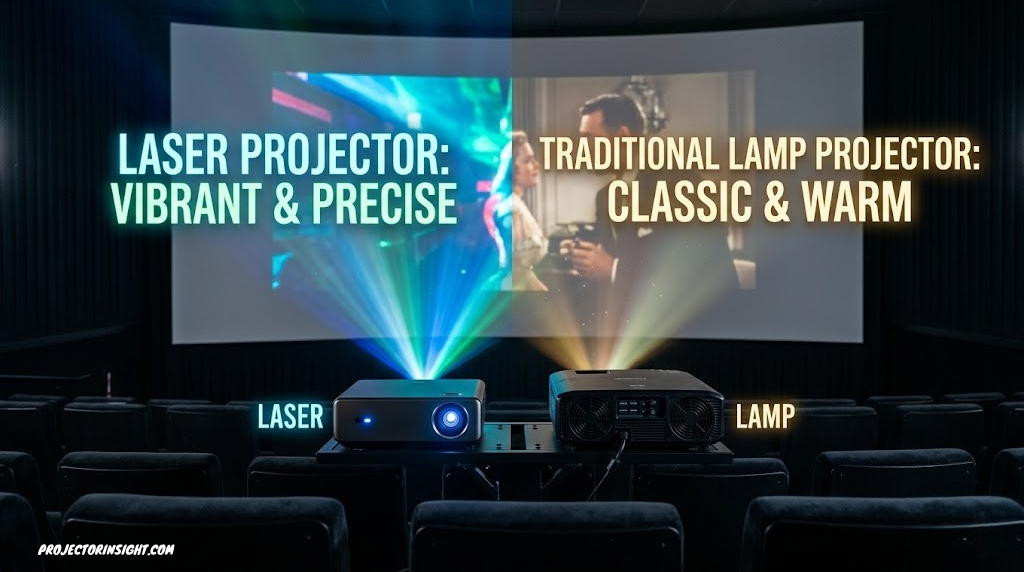
Laser vs Lamp Projector: The Complete Buyer’s Guide to Choosing the Right Light Source
Brightness, lifespan, color, cost, maintenance — every dimension compared so you can buy with confidence, not hope.
The question of laser versus lamp isn’t just about which technology sounds more impressive — it’s about which one actually fits your room, your budget, and how you watch. This guide strips out the marketing fluff and compares these two light sources on every dimension that matters, from startup behavior to a ten-year total cost of ownership. By the end, you’ll know exactly which one to buy.
Why the Light Source Is the Most Important Spec in a Projector
When people compare projectors, they tend to focus on resolution — 1080p versus 4K — or lumen counts. But the light source underneath those specs is the engine that determines how all of them perform in practice. Two projectors with identical resolution and claimed brightness can produce dramatically different experiences depending on whether they use a laser or a lamp.
The light source affects everything: how bright the image is at launch, how that brightness changes over years of use, the color accuracy the projector can sustain, how quickly you can start watching, how much noise comes from the cooling system, and — critically for buyers — what you’ll spend on the device over its usable lifetime.
Lamp-based projectors dominated the market for decades and continue to offer excellent value, especially at lower price points. Laser projectors, which became commercially viable for consumers relatively recently, bring substantial advantages in longevity and consistency but carry a higher entry price. Neither technology is categorically superior — they serve different needs, and understanding those differences is the whole point of this guide.
Throughout this guide: UHP lamp refers to the Ultra-High Performance mercury arc bulb used in most lamp projectors. Laser-phosphor refers to the most common consumer laser system, which uses a blue laser to excite a phosphor wheel. RGB triple laser refers to the higher-end pure laser system using separate red, green, and blue lasers.
If you’re still early in the buying process, our guide on how to choose a projector covers the broader decision framework — light source is one piece of that picture alongside throw ratio, resolution, and room setup.

Browse Top-Rated Laser Projectors
From entry-level laser-phosphor models to flagship RGB triple-laser home theater machines — see the full range currently available on Amazon.
Shop Laser Projectors on Amazon →How Laser and Lamp Projectors Actually Work
Understanding the underlying technology makes the performance differences far more intuitive. These aren’t superficially different versions of the same thing — they generate light in fundamentally different ways.
UHP Lamp Technology
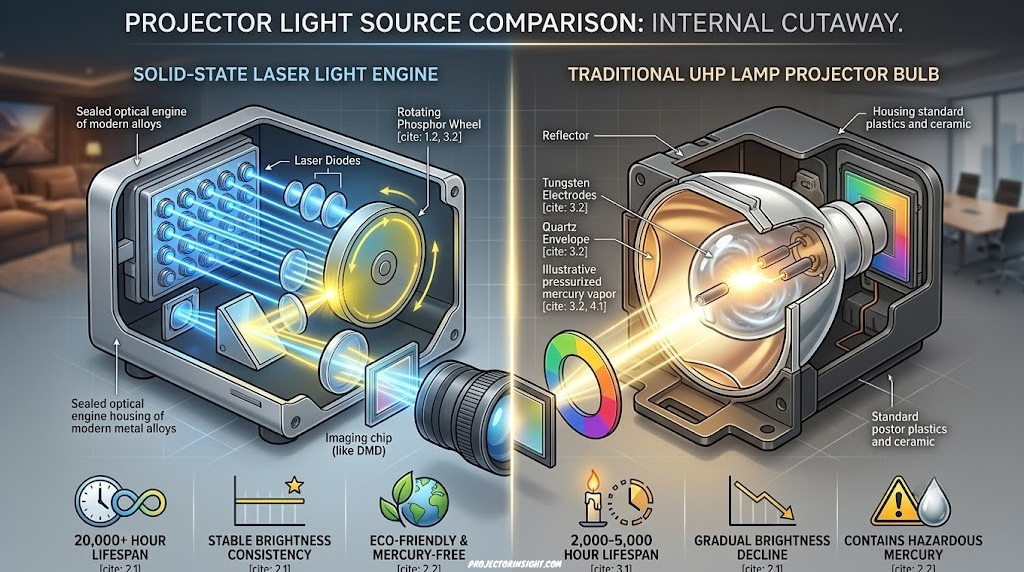
The Ultra-High Performance lamp is essentially a high-powered, high-pressure mercury arc lamp. Inside a small quartz envelope, an electric arc passes through mercury vapor and rare earth metal halides to produce an extremely bright, broad-spectrum white light. That light passes through a reflector, a series of optics, and the image-creating panel (LCD, DLP chip, or LCoS) before reaching your screen.
The lamp generates intense heat — typically 200–300°C at the bulb — which requires active cooling via a significant fan. This is why lamp projectors have noticeable fan noise and why you must let them cool down before unplugging after use. The lamp also takes 30–60 seconds to reach full brightness after startup and takes time to cool before you can move or tilt the unit safely.
From a light quality standpoint, a new UHP lamp produces a wide color spectrum with excellent white balance. The challenge is that mercury arc chemistry degrades over time — brightness and color shift as the lamp ages. After 1,500–2,000 hours of use, most lamps are noticeably dimmer than when new, and color temperature drifts noticeably.
Laser-Phosphor Technology
The most common consumer laser projector uses what’s called a laser-phosphor architecture. A blue laser diode (or array of diodes) fires onto a spinning phosphor wheel, exciting it to produce yellow light. When combined with the original blue laser, this generates a broad white light spectrum that is then processed through the same optical and image-chip path as a lamp projector.
This design is more affordable than a full RGB laser system but delivers a much longer lifespan than a lamp — typically 20,000 hours before reaching 50% brightness. Because the light output is more stable and the laser diode degrades slowly and predictably, color consistency is significantly better over time compared to a lamp that shifts more quickly.
RGB Triple-Laser Technology
Found in premium home theater and commercial projectors, RGB triple-laser systems use dedicated red, green, and blue lasers instead of a phosphor intermediary. This allows the projector to precisely control each color channel independently, resulting in dramatically wider color gamut coverage, better color accuracy, and superior black levels compared to laser-phosphor.
This is the technology behind the most advanced 4K laser projectors on the market, and it represents the current pinnacle of consumer projection performance.
The technology type also ties into what display engine the projector uses. Most laser projectors pair their light source with DLP technology, though premium models use LCoS (liquid crystal on silicon) chips for outstanding color accuracy. Understanding this is part of the broader 3LCD vs DLP comparison worth reading if you want the full picture.
Brightness, Lumens, and Real-World Light Output
Brightness is the first number most buyers look at, and it’s also the spec most commonly misrepresented. Laser and lamp projectors both advertise their output in ANSI lumens, but the real question isn’t just what a projector outputs when new — it’s what it outputs after a year of use, and how that brightness holds up in ambient light conditions.
Brightness Ratings: New vs. Aged
A brand-new lamp projector and a laser projector at the same rated brightness will look approximately equal at launch. The divergence happens over time. UHP lamps degrade relatively quickly — by 1,500 to 2,000 hours, most are producing noticeably less light than their rated spec. By the time a lamp approaches its rated end-of-life (typically 3,000–5,000 hours in normal mode), output may be at 50–60% of original brightness.
Laser light sources degrade much more slowly. A laser projector rated at 3,000 lumens at launch will typically still produce 2,700–2,800 lumens after 10,000 hours of use. The industry-standard measurement — half-life hours (the point at which brightness drops to 50% of original) — is 20,000 to 30,000 hours for most laser projectors versus 3,000 to 6,000 hours for most lamps.
Brightness for Different Environments
Room brightness is arguably more important than raw lumen count. In a fully dark, dedicated home theater room, 1,500–2,000 lumens is more than sufficient for a vivid, immersive picture. In a living room with ambient light — windows, overhead lighting — you want 2,500 lumens minimum, and brighter rooms may demand 3,500+ for a usable image.
High-output laser projectors — including many of the best projectors for bright rooms — now exceed 4,000 to 6,000 lumens while maintaining excellent color, something that was historically difficult for lamp projectors to achieve without color accuracy sacrifices at maximum lamp output.
In a dedicated dark home theater, contrast matters more than raw brightness. A projector with lower lumens but higher native contrast will often look better than a brighter projector with mediocre black levels. This is where RGB triple-laser technology earns its premium price.
Lifespan, Reliability, and Maintenance: The Long Game
This is where laser and lamp projectors diverge most dramatically in terms of real-world ownership experience. For many buyers — especially those in commercial, educational, or high-use home theater settings — this single dimension can justify the entire price premium of a laser projector.
Lamp Projector Lifespan
A standard UHP lamp projector comes with a lamp rated for roughly 3,000–5,000 hours in normal mode. Most projectors also offer an “eco mode” that reduces brightness (typically by 20–40%) and extends lamp life to 6,000–10,000 hours. The tradeoff is a noticeably dimmer image.
Here’s the practical reality of lamp ownership: the lamp doesn’t just reach its rated hours and stop — it dims gradually and then usually fails suddenly (often mid-session). Replacement lamps cost between $50 and $300 depending on the brand, with many premium projectors requiring proprietary bulbs at the higher end of that range.
Lamp failure is also not the only maintenance concern. Lamp projectors require periodic filter cleaning (every 200–300 hours in dusty environments) and must always be placed horizontally or within a specific angle range — many lamps are highly sensitive to tilt, which can cause premature failure or even shatter the bulb in extreme cases.
Laser Projector Lifespan
Laser projectors — particularly laser-phosphor designs — are rated for 20,000 hours before reaching 50% of original brightness. That’s approximately the usage equivalent of watching 4 hours of content every single day for nearly 14 years. For most home users, the projector’s other components (capacitors, fans, optics) are likely to reach the end of their useful life before the laser light source does.
There is no lamp to replace, no filter to clean on the same schedule, and no bulb-failure risk mid-movie. The only maintenance consideration is occasional exterior cleaning and ensuring adequate ventilation for the chassis cooling system.
For businesses, classrooms, home theaters with heavy daily use, and any installation where downtime for lamp replacement is disruptive, laser projectors deliver a fundamentally better ownership experience. The maintenance-free operation alone justifies a significant portion of the price premium over time.

Replacement Lamp Projectors — Great Value Right Now
High-quality lamp projectors remain exceptional value for buyers with lighter use patterns. Browse current top-rated models that punch above their price with outstanding image quality.
Shop Lamp Projectors on Amazon →Image Quality, Color Accuracy, and Color Gamut
Image quality is where the laser vs. lamp debate gets more nuanced. It’s not as simple as “laser is always better” — a lot depends on the specific projector, its image-processing engine, and how long both projectors have been in use.
Color Accuracy and Gamut
A new, well-calibrated UHP lamp projector can achieve excellent color accuracy, often covering a broad portion of the Rec. 709 color space used for standard HD content. The limitation is consistency over time. As the lamp ages, its spectral output shifts — typically toward a warmer (yellower) color temperature — causing colors to drift from calibrated values. Keeping a lamp projector properly calibrated requires periodic recalibration as the lamp ages.
Laser-phosphor projectors maintain more stable color output over time because the spectral characteristics of the laser and phosphor system change very little with age. RGB triple-laser projectors take this further — they can cover significantly wider color gamuts (DCI-P3, Rec. 2020 partial coverage), producing colors that are simply not achievable with a lamp or phosphor-wheel system. This matters increasingly for HDR content, where a wider color gamut allows the projector to represent highlights and saturated colors with greater accuracy.
HDR Performance
High Dynamic Range content requires two things: sufficient peak brightness and sufficient contrast range. This is an area where top-tier laser projectors pull ahead of all lamp competitors. RGB laser projectors can reach peak brightness levels (in specific bright scene zones) that exceed what most lamps can sustain, while simultaneously maintaining better black levels — expanding the effective dynamic range of the presentation.
For a detailed look at how contrast affects image quality, see our guide on projectors with the highest contrast ratio.
Rainbow Effect (DLP-Specific)
One quirk that affects some DLP lamp projectors is the “rainbow effect” — a flash of color fringing visible to some viewers when looking across high-contrast edges on screen. This is caused by the spinning color wheel that lamp-based DLP projectors require. Many high-speed color wheels (6-segment, fast-spinning) significantly reduce this effect, but it doesn’t disappear entirely for sensitive viewers.
DLP laser projectors, particularly single-chip models without a color wheel, largely eliminate the rainbow effect because the laser system can use a different color generation approach. This is a quality-of-life win for viewers who are sensitive to the artifact.
◈ Laser: Color Strengths
- Stable color over 20,000+ hours
- Wider gamut with RGB triple laser
- Consistent white balance over time
- Better HDR highlight performance
- No rainbow effect (most designs)
- Better color volume at high brightness
◉ Lamp: Color Strengths
- Excellent accuracy when new/calibrated
- Natural white balance out of box
- Broad Rec. 709 coverage achievable
- Premium lamp models match laser quality when fresh
- Wide selection of calibrated cinema modes
Contrast Ratios and Black Level Performance
Contrast — the ratio between the brightest and darkest areas a projector can produce — is arguably more important than resolution for perceived image quality in a dark room. Deep blacks make highlights pop; elevated blacks (sometimes called “crushed blacks” or “elevated floor”) make the image look washed out and reduce perceived detail in shadow areas.
How Lamp Projectors Handle Contrast
Lamp projectors use a constant, always-on light source. To produce a dark scene, they either close an iris (dynamic iris) that restricts light mechanically, or they rely on the image panel’s ability to block light. Neither approach produces truly deep blacks — some light always “leaks” through. High-end lamp projectors with good dynamic iris systems achieve excellent perceived contrast in content that alternates between bright and dark scenes, but truly simultaneous on-screen contrast (bright and dark areas in the same frame) is limited by how much the lamp’s light leaks through dark pixel areas.
How Laser Projectors Handle Contrast
Laser projectors have a significant potential advantage here. Because the laser diode can modulate its output (turn down or off nearly instantly), advanced laser designs can dim the light source itself during dark scenes — essentially a pixel-level or scene-level dynamic dimming that produces deeper blacks than any mechanical iris can achieve.
RGB triple-laser projectors take this further, with each color channel independently adjustable and some designs achieving native contrast ratios (without dynamic modulation) that far exceed any lamp projector. The Epson LS12000 vs JVC NZ500 comparison shows how this plays out in practice between two flagship laser and lamp-alternative designs.
Manufacturers advertise both “dynamic” contrast (with iris fully open vs. fully closed, measured across two separate frames) and “native” or “on/off” contrast (the actual simultaneous on-screen ratio). Native contrast is the more meaningful metric for real-world viewing. A projector with 50,000:1 dynamic contrast but only 1,500:1 native contrast will not produce as deep blacks as a projector with 20,000:1 native contrast.

Best 4K Laser Projectors — Expert Picks
Our curated list of the top 4K laser projectors across every budget — from value laser-phosphor models to high-end RGB triple-laser cinema machines.
Shop 4K Laser Projectors on Amazon →Startup Time, Operating Temperature, and Fan Noise
These are the everyday usability factors that marketing materials rarely emphasize, but that affect your experience every single time you use the projector.
Startup and Shutdown Behavior
Lamp projectors require a warm-up period. After pressing the power button, most lamp projectors take 30–60 seconds to reach full brightness as the arc lamp heats up. At shutdown, the lamp must cool down actively — the fan continues running for 90 seconds to several minutes after you press power off. During this cooling period, you cannot unplug or move the projector without risking premature lamp failure or, in extreme cases, cracking the hot quartz bulb.
Laser projectors are essentially instant on, instant off. Power button pressed — full brightness in 2–5 seconds. Power button held — lamp shuts down immediately, no cooling cycle required. You can unplug, tilt, or move a laser projector immediately after switching off. For impromptu viewing, presentations, or gaming setups where you turn the projector on and off frequently, this is a genuinely transformative quality-of-life difference.
Fan Noise and Operating Temperature
Lamp projectors generate substantial heat and require powerful cooling fans as a result. Fan noise in lamp projectors ranges from around 26–32 dB in eco mode to 36–42 dB in full-power mode. In a quiet dark room, 36–42 dB is noticeable — comparable to a quiet air conditioning unit running constantly in the background. Many viewers find this distracting, especially during quiet dialogue-heavy scenes.
Laser projectors generally run quieter because their light source generates less heat than a lamp. Fan noise in consumer laser projectors ranges from roughly 22–28 dB, with some fanless or near-silent compact designs going even lower. In a dedicated home theater room, this difference in ambient noise floor makes a real difference to the emotional impact of quiet viewing moments.
| Factor | Lamp Projector | Laser Projector |
|---|---|---|
| Startup time to full brightness | 30–60 seconds | 2–5 seconds |
| Cooldown required after shutdown | 90 sec – 3 min (fan runs) | None — instant off |
| Can move immediately after off? | No — wait for cooldown | Yes — immediately |
| Typical fan noise (full power) | 34–42 dB | 22–30 dB |
| Operating temperature (chassis) | Noticeably warm/hot | Warm, rarely hot |
| Tilt sensitivity during operation | High (many lamps are tilt-sensitive) | Low — full 360° orientation support on most |
| Altitude limitations | Requires eco/altitude mode above ~5,000 ft | More tolerant, varies by model |
The orientation freedom of laser projectors is particularly important for ceiling-mount or unconventional installations. Many laser projectors support full 360-degree placement — on their side, flipped, angled. This makes ceiling-mounting and creative installation configurations more flexible. Most lamp projectors, by contrast, require nearly-horizontal placement to avoid premature lamp degradation or failure.
Cost Comparison: Upfront Price vs Total Cost of Ownership
Laser projectors cost more upfront. That’s the unavoidable starting point of this conversation. But “more expensive” is more complicated than the sticker price suggests when you account for the full lifetime of ownership. Here’s the honest breakdown.
Upfront Price Comparison
Entry-level lamp projectors for home use start around $300–$500 and offer 1080p resolution with 2,500–3,500 lumens. Comparable entry-level laser projectors — delivering similar brightness and resolution — start around $700–$1,200. The price premium for laser at this tier is roughly 2–3x.
In the mid-range ($1,000–$3,000), premium lamp projectors offer excellent 4K-capable image quality, while laser projectors in this range include top-rated sub-$1,000 and sub-$500 lamp options alongside entry laser models. At the high end ($3,000+), lamp projectors include prestigious JVC and Sony models with exceptional image quality, while laser projectors include the most advanced consumer RGB systems.
Total Cost of Ownership: The Math
Let’s compare a hypothetical lamp projector and laser projector over 10 years, assuming 3 hours of daily use (approximately 1,095 hours per year):
| Cost Factor | Lamp Projector ($700) | Laser Projector ($1,400) |
|---|---|---|
| Purchase price | $700 | $1,400 |
| Lamp replacements over 10 years | ~3–4 lamps × $120 avg = $360–$480 | None required |
| Filter replacements / cleaning | Occasional (minimal cost) | Minimal |
| Electricity (assuming similar wattage) | Similar | Similar (laser often slightly lower) |
| 10-Year Total Cost | $1,060–$1,180 | $1,400 |
| Image quality at year 10 | Lamp on 3rd–4th cycle, ~3 yrs on current bulb | ~85–90% of original brightness, consistent color |
As the math shows, a $700 gap at purchase can close significantly — or even reverse — over a 10-year ownership horizon for regular users. Heavier users (4–6 hours daily) go through lamps faster, which accelerates the break-even point for laser.
If your total budget is under $600, an excellent lamp projector is the right call — there are no laser projectors at that price point worth recommending. For budgets over $1,000, laser starts to become the better long-term investment for regular users. Check our full projectors for every budget guide for specific recommendations at each price tier.
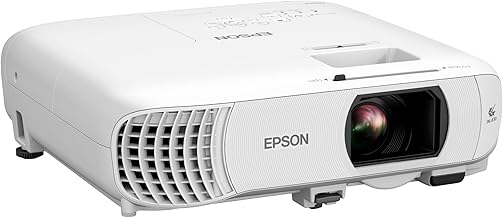
Best Budget Lamp Projectors — Outstanding Value Picks
Not every great projector needs a laser light source. These lamp-based models offer exceptional image quality per dollar — the smart pick for buyers with tighter budgets or lighter usage patterns.
Shop Lamp Projectors on Amazon →Which to Choose: Use Case Recommendations
With the technical groundwork laid, here’s a direct guide to which technology wins for specific use scenarios. No hedging — these are concrete recommendations based on what each technology does best in practice.
Dedicated Home Theater
◈ Laser PreferredDark room, daily use, color accuracy matters. RGB laser projectors or premium laser-phosphor models deliver the best consistent image quality over years of heavy use.
Budget Home Cinema
◉ Lamp is Best ValueUnder $700, lamp projectors are the only viable option. Several excellent 1080p lamp models deliver cinematic quality without requiring laser-level investment.
Gaming Setup
◈ Laser PreferredInstant-on, no warmup, low input lag on modern laser gaming projectors. Explore the top 4K 120Hz gaming projectors for dedicated gaming setups.
Bright Living Room
◈ Laser PreferredHigh-output laser projectors hold up in ambient light better than lamps. Consider bright room projector picks specifically tested in ambient light.
Outdoor Movie Nights
Either WorksPortability and brightness both matter outdoors. Outdoor movie projectors span both technologies — choose based on budget and how often you use it.
Business Presentations
◈ Laser PreferredNo warm-up, no mid-presentation lamp failure, no maintenance overhead. For frequent professional use, laser is the only sensible choice. See business projector recommendations.
Portable / Mini Use
Either WorksCompact laser pico projectors exist but are expensive. Portable lamp projectors offer good brightness per dollar for occasional use. See portable projector picks.
Golf Simulator
◈ Laser PreferredSimulator projectors run for hours daily, making lamp longevity a real concern. Golf simulator projectors increasingly favor laser for this reason.
Ultra-Short Throw Setup
◈ Laser DominantThe UST projector category is almost exclusively laser today. The best ultra-short throw projectors all use laser-phosphor or RGB laser light sources.
3D Home Cinema
◉ Lamp CompetitivePremium lamp projectors with high brightness 3D modes remain competitive. See 3D home cinema projectors for models tested specifically for 3D performance.
Full Head-to-Head: Every Dimension Compared
This is the complete reference table — every major performance and ownership dimension, side by side, with a clear verdict for each.
| Category | Lamp Projector | Laser Projector | Winner |
|---|---|---|---|
| Light source lifespan | 3,000–10,000 hrs (with replacements) | 20,000–30,000 hrs | ◈ Laser |
| Upfront purchase price | $300 – $5,000+ | $700 – $10,000+ | ◉ Lamp |
| Total 10-yr cost of ownership | Higher for heavy users (lamp costs) | Lower for 3+ hrs/day users | ◈ Laser (heavy users) |
| Startup time | 30–60 seconds warm-up | 2–5 seconds | ◈ Laser |
| Shutdown behavior | Cooldown required (1–3 min fan) | Instant off — unplug immediately | ◈ Laser |
| Fan noise | 34–42 dB (full power) | 22–30 dB | ◈ Laser |
| Color accuracy (new) | Excellent, wide Rec. 709 coverage | Excellent to outstanding (RGB = wider gamut) | Tie / RGB laser wins |
| Color consistency over time | Drifts noticeably after 2,000+ hrs | Stable for 20,000+ hrs | ◈ Laser |
| Peak brightness | 2,500–6,000 lumens | 2,000–6,000+ lumens | Tie (varies by model) |
| Contrast ratio (native) | 1,000:1 – 30,000:1 (with dynamic iris) | 2,000:1 – 100,000:1+ (RGB laser) | ◈ Laser (high-end) |
| HDR performance | Good with premium models | Better — higher peak, wider gamut | ◈ Laser |
| Rainbow effect (DLP) | Present (reduced with fast wheel) | Largely eliminated | ◈ Laser |
| Maintenance requirements | Lamp replacement + filter cleaning | Minimal — no lamp changes | ◈ Laser |
| Orientation flexibility | Mostly horizontal only | 360° support (most models) | ◈ Laser |
| Sudden failure risk | Lamp can fail unexpectedly | Very low — gradual predictable degradation | ◈ Laser |
| Entry-level availability | Excellent — many strong options under $500 | Limited under $700 | ◉ Lamp |
| Smart projector integration | Available on premium models | Common on mid-range and up | Tie |

Best Home Theater Projectors — All Budgets, Both Technologies
Our expert-curated list of the top home theater projectors includes both top-performing laser and lamp models across every price bracket — from $500 to $5,000+.
Shop Home Theater Projectors →Top Picks in Each Category
Rather than naming specific models that may change with new releases, here’s how to think about which segment of each technology delivers the best value — with pointers to our dedicated buying guides for current specific recommendations.
Best Laser Projectors by Use Case
Premium home theater (laser): Look for RGB triple-laser technology, native 4K resolution, and native contrast above 20,000:1. The high-end home cinema projector guide covers the top contenders in this segment, including flagship models with extraordinary image quality.
Mid-range 4K laser: Laser-phosphor projectors in the $1,500–$3,000 range offer excellent bang for the buck — wide color gamut, good brightness consistency, and 20,000-hour lifespan without the RGB price premium. Our 4K laser projector picks are the right starting point here.
Ultra-short throw laser: UST projectors are almost entirely laser technology at this point, for good reason — the close-to-screen placement and high brightness demands are simply better served by laser. Explore our full UST projector guide, and read about UST vs standard throw to understand whether the format suits your room.
Smart laser projectors: If you want built-in Netflix, streaming apps, and Android TV without an external streaming device, laser projectors in the smart category have improved substantially. See our smart projectors with Netflix guide for current picks.
Best Lamp Projectors by Use Case
Best budget 1080p lamp: The sub-$500 category remains lamp-dominated and competitive. Our under-$500 guide highlights models that deliver exceptional image quality per dollar — some rivaling far more expensive projectors for image quality in a controlled dark environment.
Best 1080p native lamp: Not all “4K” projectors have native 4K — many use pixel-shifting. If you want true native 1080p with excellent color and contrast, native 1080p lamp projectors remain excellent performers and offer the best combination of sharpness and affordability at the resolution.
Premium lamp projectors still competing at the top: Several premium Sony and JVC lamp (and near-lamp) designs continue to compete with — and sometimes beat — mid-range laser projectors in native contrast and overall image quality, particularly for dark-room cinema use. The home theater projector guide covers these comparisons in depth.
If you’re still deciding between a projector and a large-screen TV, our projector vs 85-inch TV comparison breaks down the key tradeoffs in detail — both laser and lamp projectors factor into that analysis.
Where Projector Light Source Technology Is Heading
The trajectory is clear: laser is the future of projector technology, and the remaining question is how quickly lamp projectors will become obsolete in each market segment. Understanding this trajectory helps inform a buying decision — particularly for buyers thinking about a projector that will serve them for many years.
Laser Costs Are Falling
As laser diode manufacturing scales, the cost premium of laser over lamp continues to compress. Entry-level laser projectors that once cost $1,500+ have now dropped below $800 at select retailers. This trend is likely to continue, eventually making the entry price of lamp and laser projectors comparable in the mid-range segment.
The Ultra-Short Throw Revolution
Ultra-short throw projectors represent the clearest signal of where the market is moving. The entire UST category — including wall-sized “laser TV” products from LG, Samsung, Hisense, and specialized AV brands — runs on laser. The design requirements of UST (high brightness, compact chassis, flexible orientation, no lamp-replacement access needed) make laser the only practical technology for this form factor.
For buyers interested in this space, pairing a UST projector with the right screen matters enormously — our guide on ALR screens for UST projectors explains why ambient light rejecting screens are essentially mandatory for UST setups in typical living rooms.
Miniaturization and Portability
Battery-powered portable laser pico projectors continue improving. Whereas first-generation laser picos sacrificed significant brightness to fit into small form factors, newer designs deliver 500–1,000+ ANSI lumens in compact, rechargeable packages. The portable mini projector segment is one of the fastest-evolving in the category.
What This Means for Buyers Right Now
If you’re buying a projector that you expect to use for 5+ years, laser is the better long-term bet — both for the technology’s inherent lifespan advantages and because lamp replacement parts, support, and accessories for aging lamp models will become harder to source as lamp projectors exit the mainstream market over time.
For buyers focused purely on maximum image quality per dollar spent today, some premium lamp projectors still compete at their price point — particularly in the sub-$1,000 range where lamp projectors still offer better specifications than equivalently-priced laser models. But that window is narrowing with each product generation.
✓ Buy Laser If You…
- Watch 3+ hours daily
- Want minimal maintenance
- Need instant on/off convenience
- Value consistent color long-term
- Plan to keep the projector 5–10 years
- Want UST or non-horizontal installation
- Use it in a business/professional context
- Have a budget of $800+
✓ Buy Lamp If You…
- Have a strict budget under $700
- Watch 1–2 hours occasionally
- Want maximum image quality per dollar now
- Don’t mind occasional lamp replacements
- Already have a quality lamp projector
- Are prioritizing a specific premium model’s image quality
Ultra-Short Throw Laser Projectors — The Living Room Revolution
Sitting just inches from the wall, UST laser projectors can produce 100″+ screens in rooms where traditional projectors won’t fit. Browse current top-rated UST models available now.
Shop UST Laser Projectors on Amazon →Frequently Asked Questions
Conclusion: The Right Light Source for Your Setup
The laser vs. lamp debate doesn’t have a single correct answer — it has a correct answer for your specific situation. For most buyers who plan to use their projector regularly and keep it for years, laser is the better long-term investment. The combination of maintenance-free operation, consistent image quality, instant startup, and competitive total cost of ownership adds up to a genuinely superior ownership experience for serious users.
Lamp projectors aren’t obsolete, though. They remain the right call for budget-focused buyers, occasional users, and anyone who wants maximum image quality at a specific price point where the best lamp models still outperform their laser competitors. Premium lamp projectors from top-tier manufacturers continue to deliver outstanding cinematic performance that doesn’t require an apology.
The clearest signal for decision-making: if your budget exceeds $1,000 and you’ll use your projector three or more hours a day, buy laser. If your budget is under $700 or you’re an occasional user, buy the best lamp projector you can afford. Everything between those two cases depends on your priorities — use this guide and our linked resources to make that call with confidence.
Find Your Perfect Projector
Ready to put the research into practice? Our full projector buying guide covers every setup type, budget range, and use case — with specific model recommendations updated for current availability.
Read the Complete Projector Buying Guide →
Pingback: BenQ Projector Review: Complete Guide to Their Best Models