The Ultimate Guide to Choosing Between Ultra Short Throw and Standard Throw Projectors
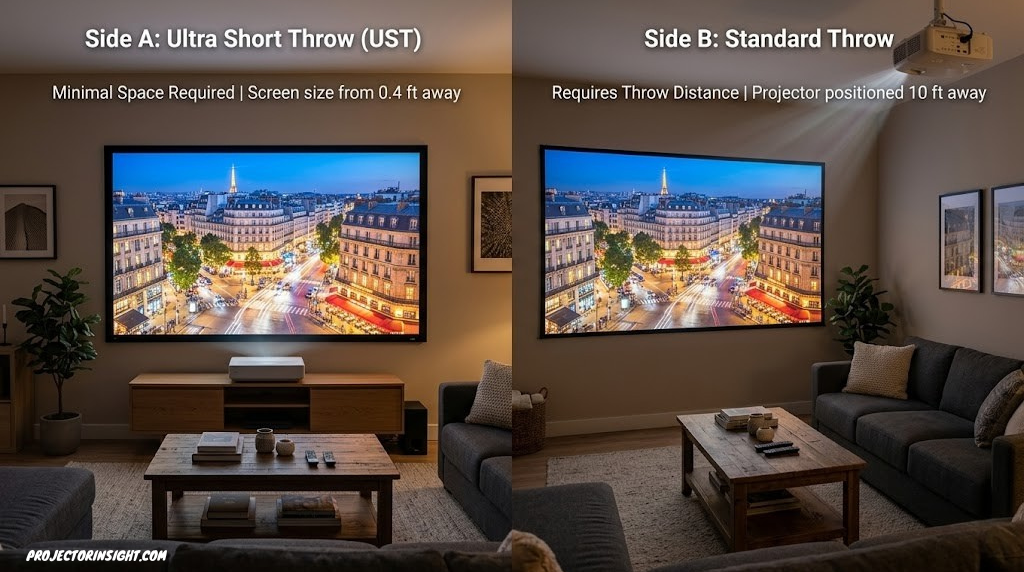
Welcome to the definitive breakdown of the two most prominent home theater projection formats in the modern era. Whether you are building a dedicated subterranean cinema room or upgrading your bright, airy living room, the battle between UST projectors vs standard throw projectors is the most critical decision you will make. In this comprehensive guide, we will analyze throw ratios, screen technologies, installation complexities, and overall value to help you make the perfect choice for your cinematic lifestyle.
1. What is a Standard Throw Projector?
For decades, the standard throw projector has been the undisputed king of the home theater. By definition, a standard throw projector is designed to sit far back from the projection screen—usually at the back of the room, mounted high on the ceiling, or placed securely on a rear shelf. These units typically feature a throw ratio of 1.2:1 to 2.0:1 or greater, meaning they need a considerable distance to cast a massive 100-inch to 150-inch image.
Standard throw technology remains the backbone of commercial cinemas and high-end residential theaters. Because the lens does not have to bend light at an extreme angle (unlike a UST), manufacturers can equip these projectors with high-quality, long-zoom optical glass that delivers impeccable edge-to-edge sharpness and uniformity. If you are exploring the best home theater projectors on the market, you will notice that the vast majority of flagship, reference-grade models utilize standard throw lenses.
Pros of Standard Throw
- Superior optical sharpness and lens quality.
- No geometric distortion at the edges.
- Incredible black levels and contrast ratios.
- Often cheaper at the entry-level.
- Flexible screen choices (matte white, grey).
Cons of Standard Throw
- Requires a long, uninterrupted optical path.
- People walking in front cast shadows.
- Complex ceiling installation and cable routing.
- Often requires a pitch-black dedicated room.

2. What is an Ultra Short Throw (UST) Projector?
The Ultra Short Throw (UST) projector represents the most exciting evolution in modern home entertainment. Unlike traditional models, a UST projector sits directly below (and slightly in front of) the screen—usually resting on an existing TV stand or media console. With throw ratios typically below 0.3:1, these modern marvels can project a massive 100-inch to 120-inch image from just inches away from the wall.
To achieve this optical witchcraft, UST projectors utilize highly complex mirror systems and custom-shaped lenses that bounce the light out at a drastic, steep angle. Nearly all premium UST projectors on the market today employ solid-state laser light sources. This means they power on instantly, run cooler, and last upwards of 25,000 hours without ever needing a bulb replacement. If you’ve been searching for the best ultra short throw projectors, you already know they are marketed as direct “Laser TV” replacements for massive flat screens.
Pros of UST Projectors
- Sits right against the wall; no ceiling mounting.
- No shadows from people walking through the room.
- Acts as a direct projector vs 85 inch TV alternative.
- Usually features incredibly potent built-in soundbars.
- Excellent for bright living room environments.
Cons of UST Projectors
- Focus uniformity can be slightly soft at the top corners.
- Absolutely requires a perfectly flat, specialized ALR screen.
- Hardware is bulky and difficult to hide.
- Higher starting price tag.

3. The Throw Ratio Explained
To truly grasp the UST projector vs standard throw debate, you must understand the mathematics of projection: the Throw Ratio. This specific metric indicates how wide the image will be based on how far the projector lens is from the screen. The formula is simple: Throw Distance = Image Width x Throw Ratio.
Let’s visualize this with a standard 100-inch diagonal screen (which is roughly 87 inches wide):
- Standard Throw (1.5:1 Ratio): You must place the projector lens roughly 130.5 inches (almost 11 feet) away from the screen to fill it.
- Short Throw (0.8:1 Ratio): You need roughly 69.6 inches (nearly 6 feet) of distance. (These are great for golf simulators).
- Ultra Short Throw (0.25:1 Ratio): You only need about 21.7 inches of distance from the lens to the screen. Because the lens is at the back of the chassis, the back of the projector itself might only be 6 or 7 inches away from the wall!
If you are confused about your specific room dimensions, you should learn how to properly calculate projector throw distance before making any purchasing decisions. Buying a standard throw projector for a tiny room will result in an unpleasantly small image, while buying a UST for a room where you *want* the tech hidden away at the back will defeat its purpose.

4. Room Size & Placement Dynamics
The architecture and layout of your viewing space dictate which technology will serve you best. Standard throw projectors require an unimpeded “light path.” If you have ceiling fans, low hanging light fixtures, or a room where kids and pets frequently run around, a standard throw beam will be constantly interrupted, casting large black shadows on the screen.
Conversely, the Ultra Short Throw projector was engineered specifically to solve modern architectural limitations. Because it sits mere inches from the wall, the light shoots directly up. No one can walk in front of the beam. However, placement is highly restricted. The top of your media console must be perfectly level, and its height must perfectly match the offset of the UST to hit the screen properly. There is very little zoom or vertical lens shift on a UST compared to traditional models.
For large, cavernous rooms where you want the biggest screen possible, the standard throw reigns supreme. For multi-purpose living spaces, the UST is the ultimate centerpiece. Whether you need a business presentation projector or a projector for every budget and room size, spatial awareness is your first filter.

5. Screen Requirements & ALR Technology
Perhaps the most misunderstood aspect of the UST projector vs standard throw comparison is the screen requirement. You cannot use a standard matte white pull-down screen with an Ultra Short Throw projector. If you do, the steep angle of the light will highlight every single wrinkle, wave, and imperfection in the fabric, resulting in a distorted, unwatchable image.
UST projectors demand a perfectly tensioned, fixed-frame screen. More importantly, they require a specific type of Ambient Light Rejecting (ALR) technology called a Lenticular Screen. A lenticular ALR screen for a UST projector is covered in microscopic, sawtooth-shaped ridges. The bottom of the ridge catches the light coming up from the UST and bounces it straight out to the viewer, while the black-coated top of the ridge absorbs overhead lighting from the ceiling. This allows the UST to look like a massive glowing television even in broad daylight.
Standard throw projectors, on the other hand, can use basic matte white screens in dark rooms, or standard ALR screens (angular reflective) for environments with some ambient light. Because the light hits the screen head-on, traditional screens are significantly cheaper to manufacture and purchase than complex UST lenticular variants.

6. Brightness, Contrast, and Ambient Light
When battling ambient light, sheer output is critical. You might wonder what are ANSI lumens? It is the standardized measurement of projector brightness. Most modern USTs act as 4K laser projectors, outputting between 2,500 and 4,000 ANSI lumens. Because the light source is so incredibly close to the screen, very little brightness is lost to light scatter in the air, giving the image massive punch and saturation.
However, when we discuss absolute, reference-level contrast—the deep, inky blacks required for a true cinematic experience—the standard throw format still holds the crown. High-end traditional projectors (like JVC and Sony) utilize advanced liquid crystal on silicon (LCoS) panels and standard throw lenses to produce the highest contrast ratios available. If you are comparing an Epson LS12000 vs JVC NZ500 (both standard throw), you will witness black levels that no current UST can replicate.
If you have a bat-cave style theater with dark walls, standard throw provides the superior cinematic image. If you are looking for the best projectors for bright rooms where the walls are white and the windows are open, a laser-driven UST paired with an ALR screen will annihilate any standard throw setup in perceived daytime contrast.

7. Installation Complexity and Mounting
The installation workflows for these two devices could not be more different. Installing a standard throw projector involves finding the center of your screen, measuring the throw distance to the ceiling, locating a ceiling joist, running power, routing long HDMI fiber-optic cables through your drywall, and carefully securing a heavy bracket. Learning how to mount a projector to the ceiling is a project that often requires hiring an A/V professional or an electrician.
The UST projector, conversely, is heavily marketed as a plug-and-play device. You unbox it, set it on your TV stand, plug it into the wall outlet right behind the console, and hook up your Apple TV or gaming console directly to it. However, placing it on the console is only half the battle. Because there is virtually no optical zoom, aligning the image perfectly to the physical screen frame requires nudging the projector millimeters at a time. A fraction of an inch of movement at the projector can drastically tilt or skew the image on the wall. Dialing in the geometry on a UST can be an exercise in extreme patience.

8. Audio Capabilities: Built-in Soundbars vs Receivers
Standard throw projectors almost never feature usable speakers. Because the unit is mounted behind the viewer, having sound blast from the back of the room while the action occurs on the screen in front of you destroys the immersion. Therefore, standard throw setups almost universally require a dedicated A/V receiver and a surround sound speaker system.
Because UST projectors sit directly below the screen (exactly where a center-channel speaker would traditionally go), manufacturers have capitalized on this placement by integrating massive, high-fidelity soundbars right into the projector chassis. Brands often partner with premium audio houses like Harman Kardon, Bowers & Wilkins, or Yamaha to deliver Dolby Atmos-capable spatial audio directly from the device. For minimalists, this means your entire home theater audio and video system consists of just two pieces of hardware: the projector and the screen.

9. Gaming Performance and Input Lag
Gamers have strict requirements: low input lag, high refresh rates (120Hz or 240Hz), and crisp motion handling. Historically, standard throw projectors were the only option for hardcore gamers. Even today, the best 4k 120hz gaming projectors are predominantly standard throw lamp or laser models that can drop input lag down to an imperceptible 4ms at 1080p/240Hz.
However, the UST market has aggressively closed the gap. Newer generations of UST projectors feature dedicated “Game Modes” that bypass heavy video processing to achieve input lag under 20ms—well within the acceptable range for competitive first-person shooters. Plus, the massive color gamut of triple-laser USTs makes HDR gaming in titles like Cyberpunk 2077 or Horizon Forbidden West look utterly spectacular.
10. Price and Overall Value Comparison
Budget dictates the final decision for most consumers. How do these formats stack up financially?
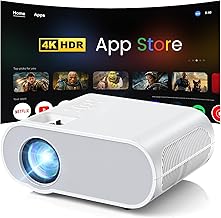
The standard throw market is incredibly vast. You can find the best projectors under $500, or even capable 1080p standard throw units if you are looking for the best projectors under $100. Even moving up to entry-level 4K, there are amazing standard throw options available when seeking the best projectors under $1000. A standard throw allows for a staggered budget: buy a decent projector now, project it onto a cheap white wall or affordable screen, and upgrade later.
UST projectors, conversely, have a high barrier to entry. Because of the complex optics, laser light engines, and built-in soundbars, quality UST models rarely drop below the mid-tier price bracket. Furthermore, because a UST absolutely requires a specialized lenticular screen to perform properly, you must factor in the cost of an ALR screen—which often costs as much as the projector itself. However, when comparing a full UST+Screen package to the cost of a massive 98-inch or 100-inch MicroLED television, the UST represents an extraordinary bargain for massive screen real estate.

11. Head-to-Head Feature Comparison Table
To summarize the complex differences between these two cinematic giants, review our side-by-side technical breakdown below. This will help you quickly reference the capabilities of standard vs ultra short throw setups.
| Feature Category | Ultra Short Throw (UST) | Standard Throw |
|---|---|---|
| Placement Distance | Inches from the screen (0.2:1 ratio) | Feet/Meters away (1.5:1 ratio) |
| Light Engine | Almost exclusively Laser (Solid State) | Lamp, LED, or Laser |
| Ideal Room Type | Living rooms, media rooms, daytime viewing | Dedicated dark home theaters |
| Screen Requirement | Strictly fixed-frame Lenticular ALR | Flexible (Matte white, grey, motorized, ALR) |
| Shadow Avoidance | Perfect (nobody can walk in front) | Susceptible to interference/heads |
| Image Sharpness (Corners) | Can be slightly soft due to steep lens angle | Pin-sharp edge-to-edge uniformity |
| Native Black Levels | Good, but reliant on ALR screen | Exceptional (in light-controlled rooms) |
| Onboard Audio | Premium integrated soundbars | Non-existent or poor quality |
12. Which One Should You Buy? The Final Verdict
Choosing between a UST projector vs standard throw comes down to understanding your space, your habits, and your budget. There is no universally “better” technology, only the correct technology for your specific application. Before deciding, make sure you know exactly how to choose a projector based on foundational home theater principles.
Buy an Ultra Short Throw Projector If:
- You want to replace your living room TV and watch content with the lights on or windows open.
- You live in an apartment or rental where mounting a heavy unit to the ceiling is impossible.
- You want an all-in-one cinematic solution with great built-in audio.
- You prefer a clean aesthetic without cables snaking across the room.
Buy a Standard Throw Projector If:
- You are building a dedicated, light-controlled basement home theater.
- You demand the absolute highest image fidelity, native contrast, and perfect edge-to-edge sharpness.
- You want a massively huge screen (150+ inches) which is very difficult and expensive for a UST to achieve.
- You have a strict budget and want to start with a native 1080p projector before upgrading to 4K later.

Conclusion: Elevate Your Viewing Experience
The projector landscape has evolved dramatically over the last decade. The standard throw projector continues to master the dark room environment, offering unparalleled optical purity for videophiles. Meanwhile, the Ultra Short Throw revolution has successfully dragged massive 100-inch+ viewing experiences out of the basement and straight into the bright, airy living room. Whether you prefer the classic cinema feel or the modern “Laser TV” aesthetic, upgrading to projection will fundamentally change how you experience movies, sports, and gaming.
Ready to make the jump? Don’t let your research stop here. Take the plunge and secure the centerpiece of your new home entertainment sanctuary today.

Browse the highest-rated ultra short throw and standard throw projectors currently dominating the market.
Shop Best-Selling Projectors on Amazon
Pingback: BenQ Projector Review: Complete Guide to Their Best Models