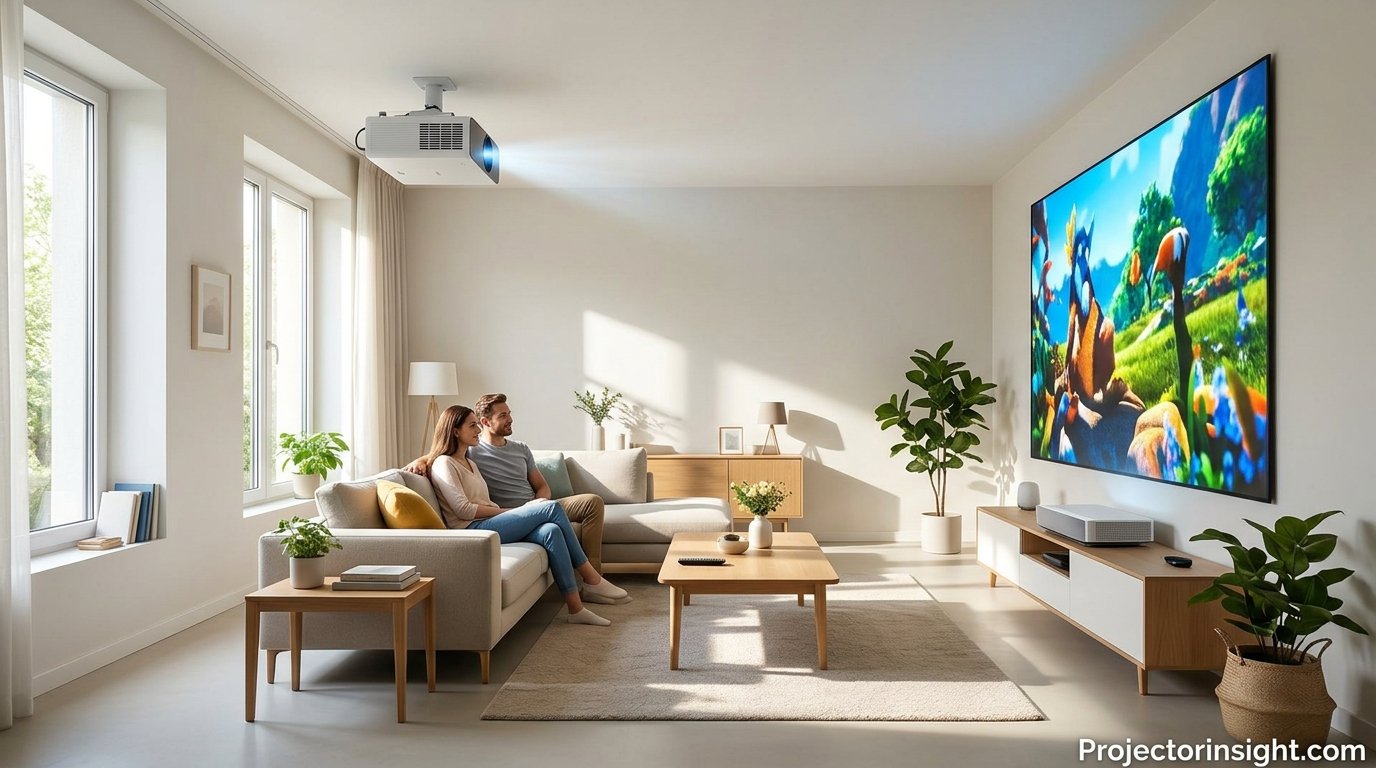
Can You Use a Projector During the Day? What Actually Works
Yes, you can. But the result depends on brightness, screen, and how much light you can tame. Here is exactly how to get a picture you will enjoy in daylight.
1. The Short Answer
You can absolutely use a projector during the day, and plenty of people do it for sports, kids’ shows, presentations, and casual streaming. What you cannot do is expect a budget projector on a white wall with sunshine pouring in to look like a cinema. Daylight adds light to the screen that the projector never asked for, and that washes out blacks and colors.
Think of it as a balance. Brighter projector, better screen, and less light hitting the screen all push the result in your favor. If you get two of the three right, daytime viewing becomes very watchable. If you want a full shopping list, our guide to the best projectors for bright rooms is the natural next stop.
What “daytime” really means
Daytime is not one condition. A north-facing room with sheer curtains at eight in the morning is a completely different challenge from a west-facing living room at two in the afternoon. Before you judge any projector, be honest about which of those rooms you have. Most disappointment comes from testing a projector in the harshest light and assuming it can never work, or from buying based on a dark-room review and expecting the same look at noon.
The good news is that modern projectors are far brighter than older ones, and prices for capable models have fallen. Families now routinely watch football, cartoons, and weekend movies with the blinds half open. The rest of this guide shows you how to stack the odds in your favor, step by step, so you spend money only where it changes what you see.
Browse bright-room projectors on Amazon.
Check Bright Room Projectors2. Why Daylight Hurts Projectors
A TV makes its own light, so it can fight the sun by simply getting brighter. A projector only bounces light off a surface. Anything else that lands on that surface, from windows, lamps, or a white ceiling, gets added to the picture.
The most important thing that suffers is contrast. Black on a projector is really just the screen without projected light. In a dark room that looks nearly black. In a bright room it looks gray, so every dark scene turns milky. Color saturation falls too, since faint colors disappear into the glare.
This is why the same projector can look stunning at night and disappointing at noon. It has not changed. The room has.
The contrast ratio problem in plain terms
Manufacturers love to advertise contrast ratios, but those figures are measured in a dark room. Ambient light collapses them. Imagine a projector with a very good native ratio of 1,000 to 1. Add enough daylight to lift the screen’s dark areas and the effective ratio can drop to something like 5 or 10 to 1. Detail in shadows vanishes, and faces in dark scenes turn into gray smears.
That is why bright, simple content survives daylight best. Sports, cartoons, news, and presentations with light backgrounds are forgiving. Moody thrillers and space epics, which live in the shadows, are the hardest. Choose what you watch in the daytime accordingly and save the dark films for evening.
If you care about contrast in general, our roundup of projectors with the highest contrast ratio shows which models handle shadows best, which also helps them cope with a little ambient light.
See projectors built to fight ambient light.
Shop High Lumen Projectors3. Lumens Explained
Lumens measure how much light a projector puts out. More lumens generally means a picture that holds up better against ambient light. But not every number on a box is honest. Many budget models advertise huge “lumens” that are measured under lenient methods, while trustworthy brands use standardized ANSI lumens.
If you are unsure how to read those specs, our explainer on what ANSI lumens are breaks it down. As a rule, an honest 2,500 ANSI lumen projector will beat a 9,000 “lumen” bargain model in real life.
Quick things to check
- Look for ANSI lumens, not just “lumens” or “LED lumens.”
- Check color brightness as well as white brightness where the brand lists it.
- Read independent reviews that measure actual output.
White brightness versus color brightness
There is a second brightness trap. Some projectors, especially single-chip DLP designs using a white segment in the color wheel, produce a high white-light number but far less brightness in actual colors. On screen this looks like a bright but pale picture. Independent testers sometimes publish both figures, and when the color number is much lower than the white number, expect washed-out color in daylight.
Why lumens fade over time
Brightness also declines. Lamp-based models can lose a large share of their output over a few thousand hours, and a projector that felt bright in the first year may struggle later. Laser and LED sources fade more slowly, but they do fade. If daytime use is your plan, leave yourself a margin rather than buying right at the minimum you calculated.
Finally, remember that the brightest picture mode often shifts colors toward green or blue. Many people happily accept that in daylight, then switch to a more accurate mode at night.
Compare projectors with verified brightness.
View Bright Projectors4. How Bright Is Bright Enough
There is no single magic number, because it depends on screen size and how much light your room gets. This table gives realistic starting points.
| Room Condition | Suggested Brightness | Expected Result |
|---|---|---|
| Curtains closed, lights off | 1,500–2,000 ANSI lumens | Good, near-evening quality |
| Some window light, curtains partly drawn | 2,500–3,500 ANSI lumens | Watchable with decent color |
| Bright room, direct daylight nearby | 3,500–5,000 ANSI lumens plus ALR screen | Good for sports and shows |
| Very sunny room, large windows | 5,000+ ANSI lumens or laser TV class | Acceptable with the right screen |
Screen size changes the math. The same projector spreads its light thinner on a larger screen, so a 100-inch image will look dimmer than an 80-inch one. If daytime is your priority, go a size smaller than you first imagined. Our guide on what size projector screen you need helps you choose.
A simple way to estimate your needs
A helpful shortcut is to think in terms of brightness per square foot of screen. Take the projector’s honest lumens, then divide by the screen’s area. Cinema standards target a modest figure in a dark room, but in daylight you want several times that. This is why a 3,000 lumen projector can look excellent on a 70-inch screen and unimpressive on a 120-inch one.
Be realistic about the window question too. A room lit by a single small window is nothing like a sunroom. If you can control the light with curtains, you can aim for the lower end of each range. If you cannot, treat the higher rows in the table as your minimum and plan to add an ALR screen.
When in doubt, buy more brightness than you think you need. A bright projector can always be dimmed with eco mode or lowered lamp settings, but a dim one cannot be made brighter. Our guide to choosing a projector shows how brightness fits with resolution, throw, and features.
Find a projector sized for your room.
Shop 4000+ Lumen Options5. The Screen Matters Most
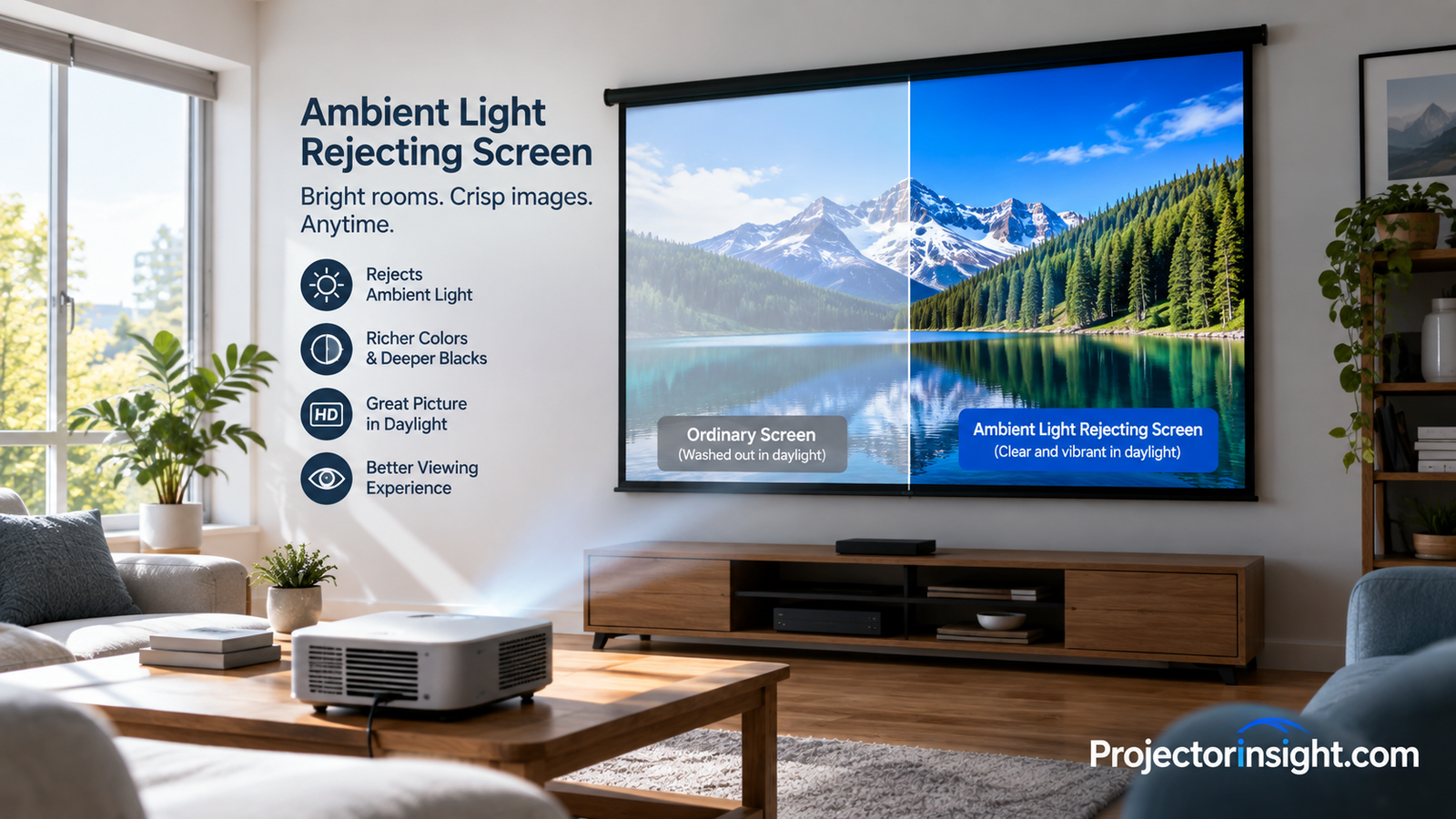
Many people spend everything on the projector and project onto a wall. That is backwards for daytime viewing. A wall reflects light from every direction, including sunlight. An ambient light rejecting screen, often called an ALR screen, is designed to reflect light from the projector while dimming light from other angles.
The improvement in perceived black level can be dramatic, sometimes worth more than doubling your lumens. ALR screens work best when matched to the projector type, and our piece on the ALR screen for UST projectors covers the special case of ultra short throw setups.
Pros of ALR Screens
- Much deeper blacks in bright rooms
- Better color punch
- Lets you keep some lights on
Cons of ALR Screens
- Higher cost than plain screens
- Viewing angles can be narrower
- Must match your projector type
How ALR screens actually work
Ambient light rejecting screens use microscopic structures in their surface, such as angled ridges or lenticular layers, that act like tiny louvers. Light arriving from the expected projector angle is reflected toward the viewers, while light arriving from above or from the sides is absorbed or bounced away. Standard white screens reflect nearly everything equally, so they cannot tell the difference.
Gray screens and other cheaper options
If a full ALR screen is out of reach, a gray or high-contrast screen is a middle path. Gray surfaces absorb some room light and deepen blacks, at the cost of a little peak brightness. This trade works best with a bright projector, since you give up some light to gain contrast.
Also consider the screen’s gain. A high-gain screen reflects more light back toward viewers, which boosts brightness, but narrows the angle from which the image looks good. In a small living room with everyone seated in front, that trade is usually fine. In a wide room with seating off to the side, it can cause visible hot spots and dim edges. Match the screen to the seating layout, not just the spec sheet.
Lastly, keep the screen clean. Dust and smudges scatter light and lower contrast. Our guide on how to clean a projector screen covers safe methods that will not damage the coating.
Compare ALR projector screens.
Shop ALR Screens6. Laser, Lamp, LCD, and DLP
Light source and imaging technology both affect daytime performance. Laser projectors tend to hold brightness longer and often reach higher outputs, while lamps fade over time. If you are deciding, see our comparison of laser vs lamp projectors.
Imaging tech matters too. 3LCD models usually deliver strong color brightness, meaning colors stay as bright as whites. Single-chip DLP models can look punchy in white brightness but sometimes show less color output. We explain the trade-offs in 3LCD vs DLP projectors.
| Type | Daytime Strength | Watch Out For |
|---|---|---|
| Laser | High, steady brightness | Higher price |
| Lamp | Good at lower cost | Fades, needs replacement |
| 3LCD | Strong color brightness | Lower native contrast |
| DLP | Sharp, punchy whites | Possible rainbow effect |
Why laser earns its reputation
Laser projectors reach full brightness quickly, hold it for tens of thousands of hours, and can be built to very high outputs. For a room that stays bright every day, that steadiness is valuable. The extra cost is easiest to justify when the projector is your main display and gets heavy use.
Where lamp still makes sense
Lamp projectors remain a smart value. For a spare room, a weekend setup, or a tight budget, a lamp model with strong lumens often delivers more brightness per dollar. Just budget for a replacement lamp eventually, and use eco mode sparingly if brightness is your priority.
LED projectors and daytime
LED models are compact and long-lived, but most are not bright enough for a sunlit room. They shine in dim spaces and for portable use. If you are considering one for daytime, verify honest output before you buy.
Each type also has its own strengths in other areas such as color accuracy and noise. See our 4K laser projector picks if you are leaning toward laser.
Explore laser projectors for bright rooms.
Shop Laser Projectors7. Placement and Throw
Where the projector sits changes how bright the image looks. A projector placed closer to the screen (within its supported range) delivers a smaller, brighter picture. Use the guide on how to calculate projector throw distance to plan this before buying.
Ultra short throw models sit inches from the wall and pair naturally with ALR screens, because the light comes from below at a steep angle and the screen can reject overhead light. See UST vs standard throw and the best ultra short throw projectors for details. Also, keep the projector’s lens from facing a window, and aim the image away from direct sunlight.
Height, angle, and windows
Ceiling mounting is often the best arrangement for daytime, because the projector sits out of the way and the beam travels above viewers’ heads. If you plan to mount, our guide on mounting a projector to the ceiling walks through it safely. A projector on a low table can work, but keep people from walking through the beam.
Pay attention to lens shift and keystone features. Optical lens shift lets you move the image without distorting it, which gives you freedom to place the screen on the darkest wall. Heavy digital keystone correction can soften the picture and reduce brightness, so avoid relying on it if you can.
Pick the right wall
The ideal screen wall faces away from windows, so daylight streams in behind viewers rather than onto the screen. If your only option is a wall with a window beside it, hang a heavy curtain and consider a screen with a narrower viewing angle to reject that side light.
Compare short throw projectors.
Shop UST Projectors8. Taming the Room
Even a great setup benefits from controlling light. You do not need a blackout cave. A few changes get most of the benefit.
- Use blackout or thick curtains on windows that face the screen.
- Choose the darkest wall for the screen, ideally opposite, not beside, the windows.
- Dim light-colored surfaces near the screen, since white walls bounce light back onto it.
- Turn off overhead lights that shine on the screen and use lamps behind the seating area instead.
- Watch at the right time. Midday is hardest; morning or late afternoon light is easier.
Cheap fixes here often outperform expensive hardware. If your picture still looks soft afterward, check our guide on why a projector looks blurry, since focus problems get mistaken for glare.
Color matters more than you think
Light walls, ceilings, and floors act like giant mirrors, bouncing projector light back onto the screen and lowering contrast. A room painted a medium or dark matte shade performs much better, even in the day. If repainting is not possible, a dark area rug, dark throw blankets, and matte curtains help a surprising amount.
Layers of light control
Consider layering solutions instead of relying on one. Sheer curtains soften harsh sun while still letting in gentle light. Behind them, blackout panels or cellular shades handle the peak hours. Some people add removable window film for a lighter-touch fix in rented homes.
Sound and comfort still count
Daytime movie sessions do not need to feel like a compromise. Good audio makes a bright-room picture feel more immersive, and our guide to connecting a speaker to a projector helps you upgrade weak built-in sound. Comfortable seating and a screen at a natural eye height finish the effect.
Block light with blackout curtains.
Shop Blackout Curtains9. Daytime Outdoor Use
Outdoors in full sun is the toughest case. Ordinary projectors simply cannot compete with direct sunlight, and even very bright ones struggle. The workable approach is shade: a covered patio, an awning, or a tent, plus a high-contrast screen.
Portable models are convenient but usually lower in brightness, so expect shade to be mandatory. Browse our picks for outdoor movie projectors and portable mini projectors to see what is realistic.
Shade beats specifications outdoors
Outdoors, the sun is thousands of times brighter than any projector. The most effective upgrade is not a better projector but a shadier spot. A covered porch, pergola with fabric panels, or a canopy on the sunny side makes a bigger difference than an extra thousand lumens.
Screens for outdoor daytime
Choose a screen made for outdoor use with a matte, high-contrast surface, and anchor it well against wind. Inflatable screens are convenient but usually plain white, so pair them with shade. Position the screen so the sun is behind the viewers.
Set expectations
Even in shade, outdoor daytime viewing looks best with simple, bright content. Treat it as casual fun such as sports or cartoons for the kids, then move to evening for the cinematic experience. Also protect your gear from heat, dust, and moisture, and keep vents clear so the projector does not overheat in warm weather.
Find a projector for shaded outdoor viewing.
Shop Outdoor Projectors10. Budget Considerations
Brightness costs money. Under about a hundred dollars, honest daytime performance is not realistic. Between roughly a few hundred and a thousand dollars you begin to find genuinely bright models. Our budget roundups help: projectors under $500 and projectors under $1000.
If your budget is fixed, spend on brightness and a decent screen before chasing 4K. A bright 1080p image looks better in daylight than a dim 4K one. Not sure where to begin? Try how to choose a projector or the best projectors for every budget and room size.
Where the money goes
A useful way to spend a limited budget is to split it in thirds among brightness, screen, and accessories. That might mean a mid-priced bright projector, a modest gray or ALR screen, and blackout curtains, rather than an expensive projector on a bare wall. In daylight, that combination outperforms lopsided spending.
Watch for false economy
Ultra-cheap projectors advertise enormous numbers that rarely hold up. If you are shopping at the bottom of the market, see projectors under $100 for realistic expectations, and consider saving a bit more if daytime performance matters.
Stepping up
Once you pass a thousand dollars, options like bright laser models and ultra short throw units open up, and our list of the best high-end home cinema projectors shows what top-tier performance looks like. Many of these are built for living rooms where lights cannot always be turned off.
Also factor in running costs: replacement lamps, cleaning supplies, and mounting hardware. A slightly higher upfront price for laser can pay off if you would otherwise replace lamps repeatedly.
Compare projectors by price.
Shop Projectors Under $50011. Common Mistakes
- Trusting inflated lumen claims. Stick to ANSI figures.
- Projecting onto a bare white wall in a sunny room.
- Buying a huge screen size that spreads light too thin.
- Placing the screen opposite a window so the sun hits it directly.
- Ignoring eco or low-brightness modes. Use the brightest mode you can tolerate.
- Judging the picture too early. Test at the actual time of day you will watch.
Fixing a washed-out image
If your picture looks pale, work through the causes in order. First check the mode: cinema or movie modes are dimmer, and switching to a bright or dynamic mode can help. Then look at the room, closing curtains or turning off lights that shine on the screen. Finally consider the screen and image size. Shrinking the picture slightly is a free way to gain brightness.
Do not confuse glare with focus
A hazy image is not always about ambient light. A dirty lens can cause a low-contrast, foggy picture, and our guide on how to clean a projector lens is worth a look. Poor focus, dusty filters, and heat problems can all masquerade as a brightness issue.
Avoid over-adjusting
Cranking every slider to maximum can clip highlights and crush detail. Raise brightness modestly, adjust contrast until whites are bright but not blown out, and boost color slightly to compensate for washout. Small changes usually look more natural than extreme ones.
Upgrade your setup the right way.
Shop Projector Screens12. Daytime Setup Checklist
- Pick a projector with at least 2,500 honest ANSI lumens.
- Choose a screen size on the smaller side of your range.
- Add an ALR screen if the room stays bright.
- Place the screen on the darkest wall, away from direct sun.
- Close or dim curtains near the screen.
- Use the brightest picture mode and adjust color to taste.
- Test at midday and adjust before committing.
Follow these steps and you will get a picture that is enjoyable in daylight. For installation, see how to set up a projector.
Testing your setup
Once everything is in place, test with a few types of content: a bright sports broadcast, a colorful animated film, and a darker drama. Judge the picture from where you actually sit, not right beside the screen. If the dark scenes are unwatchable but the bright ones look great, you have a workable setup for daytime sports and family viewing, and evenings can handle the rest.
Small upgrades that add up
Consider a projector with a good remote so you can switch modes quickly, and label your favorite picture presets for day and night. A wall-mounted screen that retracts keeps the room tidy when it is not in use. Over time, add improvements as you notice weak spots, whether that is darker curtains, a better screen, or a brighter projector.
If you are connecting devices, guides on linking a phone to a projector or a laptop or Mac make streaming and presentations easy. And if you hit trouble, our fix for the HDMI no signal error saves time.
Ready to shop for a daytime projector?
Find Your ProjectorFrequently Asked Questions
Can you use a projector during the day?
Yes. With enough brightness, a good screen, and some light control, daytime viewing works well.
How many lumens do I need for daytime use?
Aim for about 2,500 to 3,500 ANSI lumens in a moderately lit room and 4,000 or more in a bright one.
Is an ALR screen worth it?
For bright rooms, usually yes. It improves black levels far more than extra lumens alone.
Can I use a projector outside in sunlight?
Direct sun is very difficult. Use shade and a bright projector for the best results.
Do laser projectors work better in daylight?
They often reach higher brightness and hold it longer, which helps in bright rooms.
Does a white wall work as a screen?
It works, but reflects ambient light too. A proper screen performs noticeably better in the day.
Should I choose 4K or brightness?
For daytime, brightness matters more. A bright 1080p picture beats a dim 4K one.
Does screen size affect brightness?
Yes. Larger images spread the same light thinner, so they look dimmer.
What time of day is best?
Morning or late afternoon is easier than midday, when light is strongest.
Are mini projectors bright enough for daytime?
Most are not. Expect to use them in dimmed or shaded spaces.
Conclusion
Using a projector during the day is entirely possible when you treat brightness, screen, and room light as a team. Choose an honestly bright projector, pair it with the right screen, and cut down the light that lands on it. You will be surprised how good daylight viewing can look.
Start with a projector made for bright rooms.
Shop Now on Amazon